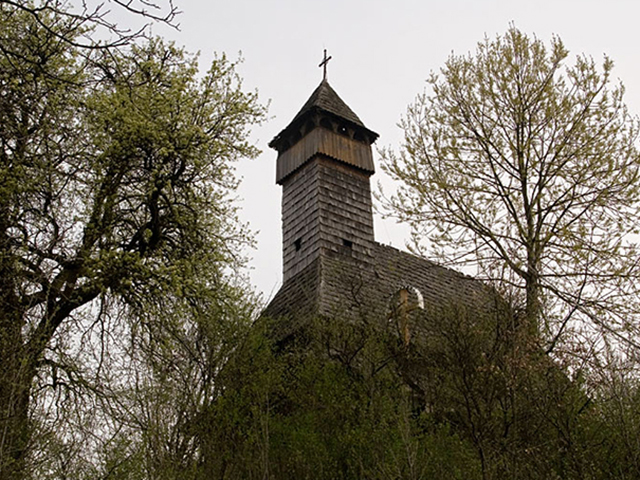
The village of Srednee Vodyanoye is one of those Ukrainian unicums, most of the inhabitants of which speak 4-5 foreign languages. People, who often do not travel outside their isolated settlement, understand and tolerantly speak Russian (a legacy of Soviet times), Slovak, Romanian, sometimes Polish and Hungarian. The presence of polyglots in Srednee Vodyanoye village is due to the fact that it was founded by Romanian shepherds who migrated from their Wallachia during its occupation by the janissaries of the Ottoman sultans.
Having found and settled a picturesque place in the intermountain hollow of the Carpathians, on the bank of the Apshitsa River, the Wallachian shepherds designated this settlement as Srednaya Apsha. In 1948, the original name was changed to Srednee Vodyanoye, but they could not do anything about the spirit of Wallachia, knowledge of the Romanian language and the ability of the locals to build original temples. There are 2 ancient churches preserved on the territory of Vodyanoye-Apshy. They are located on 2 hills, around which the village was built. Both are dedicated to St. Nicholas, the most respected saint of the Carpathians, both in Ukraine and Romania.
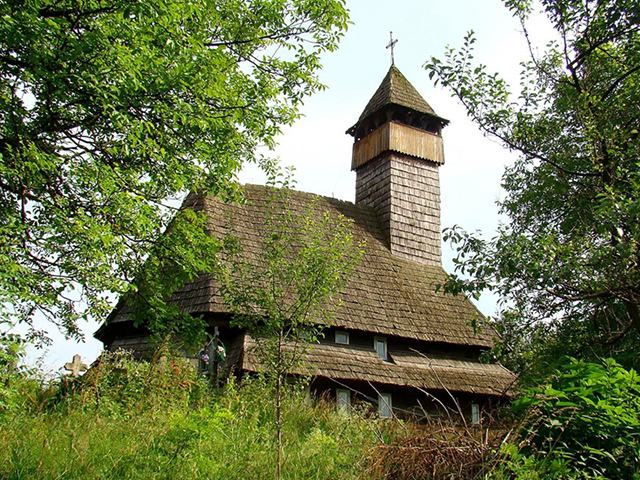 The two churches were built by one team of craftsmen. The exact date of their birth has not been preserved. Different researchers call the time of appearance of the Upper and Lower St. Nicholas churches — it may be a period from the end of the XV century to the middle of the XVII. But if the Upper St. Nicholas Church is officially considered the oldest wooden church in Ukraine, then the Lower St. Nicholas Church also deserves such a title, «pension» and honorable old age.
The appearance of this structure is radically different from the traditional sacral structures erected in the Carpathians by boykas and lemkas. The lower church is made in a typical Romanesque style, characteristic of the early Middle Ages. Apparently, the genetic memory of Wallachian migrants was triggered during the construction. Many architects compare it to the temples of Transylvania, which simultaneously with the service of God performed the role of fortifications.
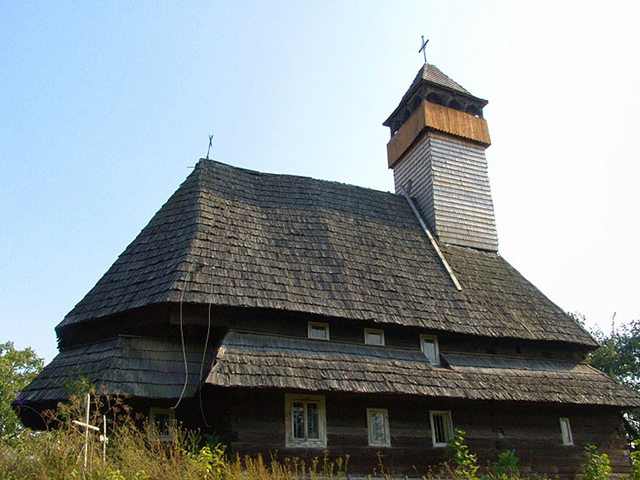 The Lower Church of St. Nicholas has one main rectangular log cabin and a smaller pentagonal one, intended for the altar. Both log cabins are covered with a single double-pitched roof, under which, like the skirt of a fly swatter, there is another roof. It is intended to protect the base of the building from precipitation. The high observation tower covered with a hipped roof deserves special attention in the construction of the temple. Atypical for Ukrainian churches is the placement of entrance doors on the south side of the building. The windows of the temple are narrow, reminiscent of loopholes in knights’ castles described in the novels of Walter Scott. The overall impression that the Lower St. Nicholas Church evokes is of a temple that is able to protect its parishioners.
But it is this wooden church of the Carpathians that needs help and salvation today. It was last restored in 1699, so the shingles with which it is covered look like anything but a finishing material. When you come to holiday in the Carpathians, you will see that this temple, although it belongs to the local Greek Catholic community, but it is not used for its intended purpose. At the foot of «his» hill rises a young, brick, shiny church. Staying on a holiday in Solotvino, Jasinja, Kvasy or Rahov, you can visit this Miracle while it still rises above Apsha, watching the world through the window-eyes of its only tower.