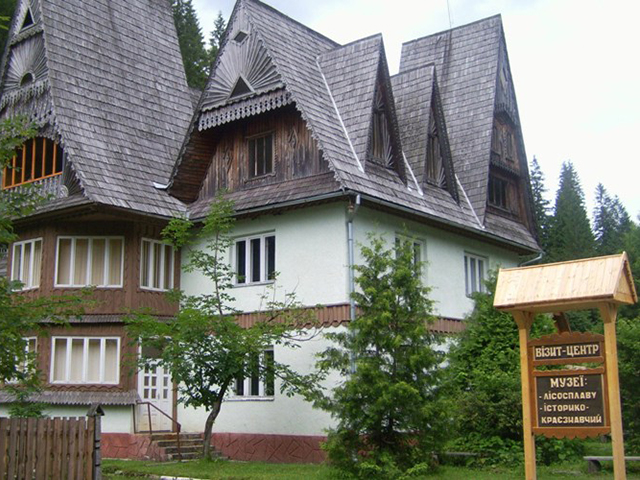
 Sinevir is a canonical lake. Young residents of Ukraine get acquainted with it in the 8th grade as the only backwater lake on the territory of the state. Water bodies of this type are plentiful in the Pamirs, Andes and Cordilleras. But here, in the Ukrainian Carpathians, it is the only water body with this type of lake depression origin.
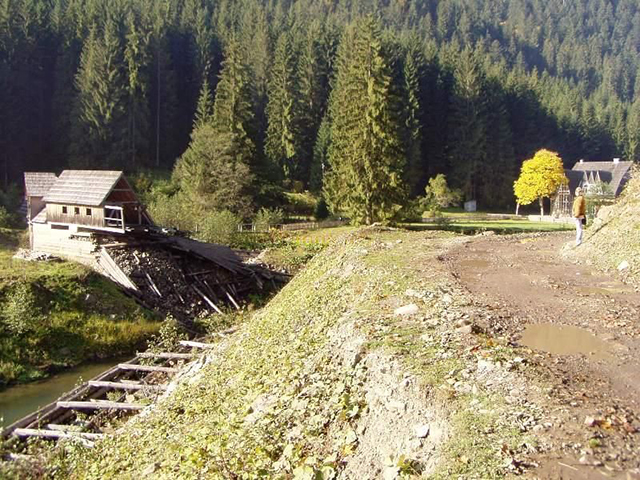
Sometimes Sinevir beauty is called «Sea Eye». The territory around it is a protected area. There is a National Park with the same name as the lake, which protects the intermountain valley blocked by rockfall, the reservoir itself, which is home to crayfish and 3 species of trout, beech and spruce forests on the slopes of the Inner Gorgans, several springs of mineral water, Gluhanya swamp and Ozirce Lake. Sinevir’s natural riches are complemented by man-made wonders. These include observation decks inscribed in the landscape by architect Yuri Solomin, the flood-ravaged Muzej of Forest and Alloy, a rehabilitation center for bears, Kolochavskaya narrow-gauge railway, and the local Museum of Regional Studies. In tourist guides the latter is sometimes referred to as the «Visit Center», and in official sources as the Museum of Architecture and Life «Old Village».
 «Visit-Center» is a typical skansen, that is such an exposition, which is located not in dusty museum halls, but under the changeable and treacherous open sky. This skansen was opened in 2007 thanks to an initiative group of fans of Transcarpathian ethnography and with the financial support of MP Stanislav Arzhivetin.
It is a «living» museum of local lore, on the territory of which the settlement characteristic for Verkhovyna before the arrival of Soviet power is fully reproduced. There are about 20 buildings on the territory of the center, corresponding to the dwellings of pre-war highlanders, engaged in various activities and with different financial possibilities.
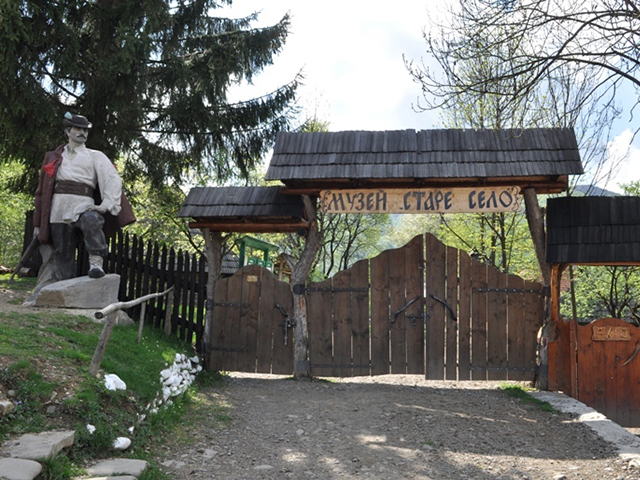 Open the massive wooden gates of the Visitor Center and walk along the paths lined with pebbles from the bottom of mountain rivers. First you will see the Logger’s and the Poor Man’s huts, the basic exhibits of the museum-skansen. From the woodcutter’s hut the road leads to the Gendarme station. Behind it are the Sheepman’s house, the Mill, the Blacksmith’s shop and the Well. The last one was built so successfully that a year later newts appeared in it. This is a good sign, a kind of local indicator of water purity. The image of a full-fledged pre-Soviet settlement was completed by a chapel and a parochial school. The amphitheater for 500 seats is a bit out of the ala-verkhovina style, but it is necessary for holding ethno-festivals, master classes and thematic conferences on the territory of the museum. All the structures were built by teams of enthusiastic volunteers, using tools and technologies of the past centuries.
This ethno-attraction of Sinevirskaya Polyana is located on the lands of Mezhigorsky district and has long been a must-see item on the route, showing tourists all the advantages of the «Sea Eye». In 2009, this museum-skansen was named the best in the country, because it makes vacation in the Carpathians as prestigious and interesting as vacations in the Alps or the Himalayas. If you plan a trip to these regions, do not miss the chance to see a Carpathian village in its pristine beauty, unspoiled by civilization and not disfigured by the buildings of the era of military communism.