Imagine a Ukrainian city whose flag and coat of arms depicts a dinosaur, three stars, a fountain and a small snake drinking from a bowl. If birds, snakes, bears, and stars are quite common in heraldry, then diplodocus, as the central element of the symbolism, can not boast of any settlement in our country. Except for Sak. This is a city located in the western part of the Crimean peninsula. It has unique balneological resources — muds of Sak Lake, Sasyk-Sivash and Kyzyl-Yar, as well as mineral waters like «Essentuki» or Crimean.
 .
.
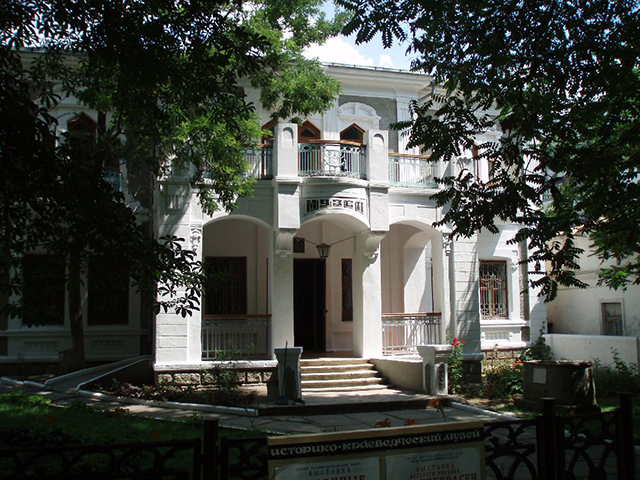
Almost all information about the therapeutic and recreational opportunities of this resort is collected in the City Museum of Local Lore. It is located on Kurortnaya Street in the house №29. There are 2 versions of the appearance of this mansion. According to one — the house was built for the residence of Tsesarevich Alexei Romanov, whose hemophilia tried to cure, relying on the healing power of the Saka mud. According to another — the building for the museum, not even assuming about its educational future, was built by the salt producer Balashov. It was his gift to the lady of his heart — Countess Panina, the Sak version of the «homeless woman».
Be that as it may, but already in 1913 the mansion of marvelous beauty decorated the Kurortnaya Street. It is a two-storey building in neoclassical style. Its facade is decorated with a porch with columns, which on the second floor turns into a graceful, spacious balcony. At the beginning of the last century such were called terraces. On them you could drink tea and look at passers-by. Two windows on the sides of the building are «embedded» in the pseudo-columns, and overhanging them are semicircular balconies, where it was so pleasant to breathe in the fresh sea air, waking up in the late-late morning after the ball.
The house was so solid and beautiful that after the revolution the new authorities were glad to settle in it. At first there was a committee of the Communist Party and Komsomol, later — district executive committee and mobilization point. Not having time to remove the documents at the impending threat of fascist occupation, the communists set fire to their archives. Naturally, with the house.
After the war the mansion was restored. It housed the city maternity hospital. In 1983, the house, recognized as an object of cultural heritage of Crimea, was given to the Museum of Local Lore. Its specialization on balneological subjects made it the only object of this kind in the CIS.
But the idea to tell the general public about the history and possibilities of mud treatment did not arise out of nowhere. The basis of the balneological city collection was laid in 1908 by surgeon Esipov and Professor Nalband, senior doctor of the Sakskaya Zemstvo mud cure clinic. They collected everything related to balneology, took samples of underground water, collected herbariums of medicinal plants in the Crimean steppe and drew plans for new, ideal in their opinion, mud cures that could provide their services to the maximum number of suffering people.
Some of these exhibits were preserved and became the basis of the Sakka Museum of Local Lore.
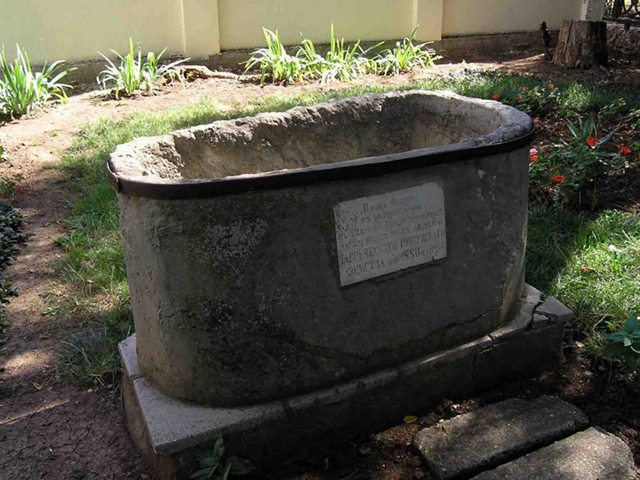
One of the most striking exhibits of the museum on the subject of balneology was an ancient stone bathtub, shackled with iron hoops. It was used in 1837-1855 for the treatment of soldiers in the Saksky department of the Simferopol military hospital. The collection is complemented by models illustrating the mud treatment technique from antiquity to the present day.
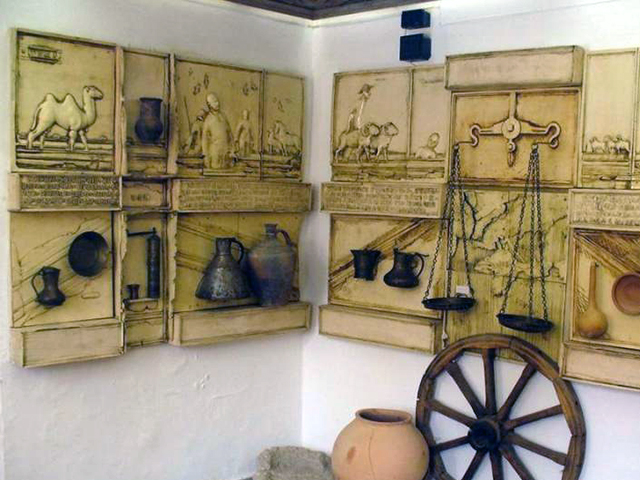
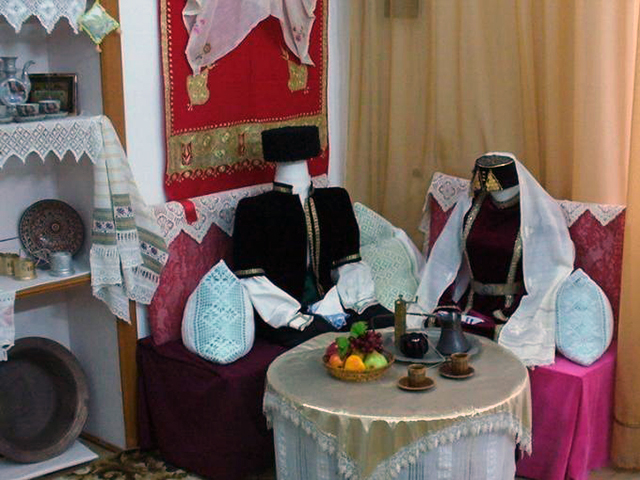
Much attention in the exposition is paid to the celebrities who stayed at different times for treatment and vacation in Crimea. These are Lesya Ukrainka and Gogol, Maximilian Voloshin and Vladimir Mayakovsky. In addition to balneology, the list of attractions of Saki continues with models of the seabed, samples of minerals, collections of shells, flora and stuffed animals. In recent years, the city Museum of Local Lore has been enriched with a hall dedicated to the culture and life of Crimean Tatars, as well as a collection of paintings by local artists. By the way, the guides — keepers of knowledge and secrets about Saki, will tell you how the dinosaur appeared on the city flag and coat of arms.