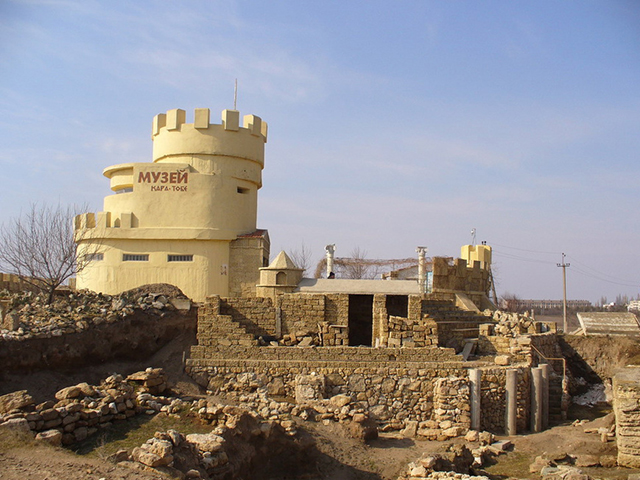
 Numerous historical studies have not yet answered the question about the age of the city of Saki. It is known only about the years of belonging of this territory to the Crimean Khanate. That is, from 1441 to 1783 there was a rural settlement belonging to the Mansurov family. But anyone who vacationed in Saki, saw the ruins of the ancient settlement Kara-Tobe, located on Morskaya Street, on the territory of the modern village Priberezhnoye. It is material evidence that this city has a history as old as Athens and Rome or Kerch and Yevpatoria.
The Kara-Tobe settlement was founded by the Sakas. These are representatives of Iranian-speaking nomadic tribes. They lived in the first millennium BC. Those Sakas, who came and settled in the Northern Black Sea coast, outwardly were similar to the Scythians. As well as in their barrows, in the necropolises of Turkic nomads were found jewelry with animal themes. But, unlike the Scythians, the Sakis did not absorb the elements of Hellenic culture, so a knowledgeable person can easily distinguish which people’s artifact he extracted from the Crimean land. By the way, the name of the settlement is 100% Saka. Kara-Tobe is translated from Turkic as «black cap», a mountain or hill.
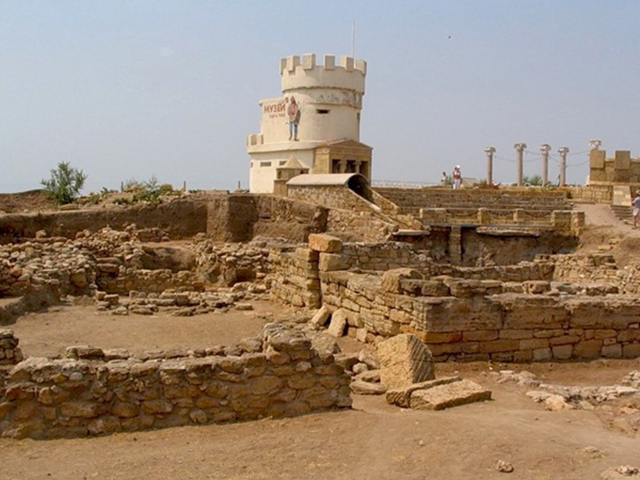 The excavations, which are conducted on the territory of the settlement, did not allow to establish the time of the appearance of the Saks in the western part of the Crimean Peninsula, near the shores of the Black Sea, Sak Lake and Sasyk-Sivash. It is only known that in the IV century BC, the Turkic nomads were knocked out of here by Greek colonists. They built a fortress on the «black hill». To fortify themselves in the fiefdom of the Saks, the Hellenes had to engage in fortification. A fortress and a defense wall were erected. Today only a huge tower-donjon, hulks of houses, cobbled streets and ruins of the eastern wall have survived. The scale of the fortification is comparable to Pompeii, the world’s largest open-air archaeological museum.
It is established that about 1500 people lived on the territory of the already Greek settlement. They were engaged in trade, crafts, agriculture. But they constantly had to repel the attacks of nomads. First the Saks, then the Scythians. This is evidenced by traces of fires, broken weapons and mutilated bones, which are constantly retrieved in the course of archaeological research at Kara-Tobe.
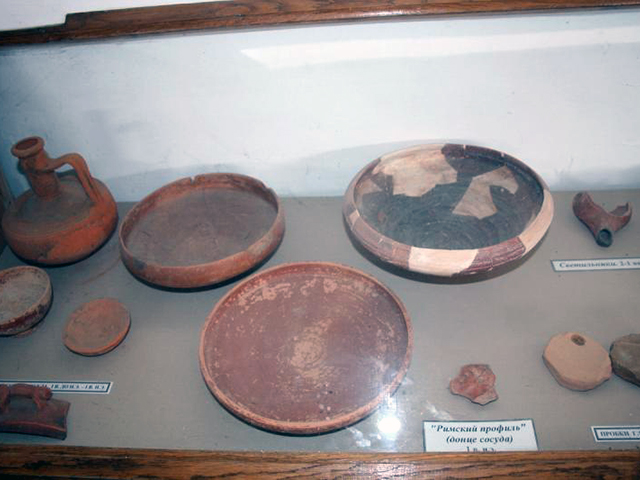 It is known that already in the I century BC Greeks were knocked out of their fortress by Scythians. And they, in turn, were expelled from the «promised land» by the troops sent by King Mithridates VI Eupator. From Kerch a punitive detachment of Diophantos was sent to the western coast of the Crimean Peninsula, which captured both Eupatoria and the fortress Kara-Tobe, close to it. In Saki itself is a very popular version of the fact that this fort at that time was named Eupatorion. And it was this name that was transferred, rather projected, to the city of Yevpatoria.
It is curious that after the death of Mithridates the Greeks left the city, and the Scythians settled there again. Therefore, the ancient settlement of Kara-Tobe is like a legendary kulebyaka, in which under one cultural layer is hidden another, even older and more interesting. The Roman garrison took part in the preparation of Saka historical «kulebyaka». About his presence in the Crimea told the treasure trove found on the territory of the settlement, consisting of many coins.
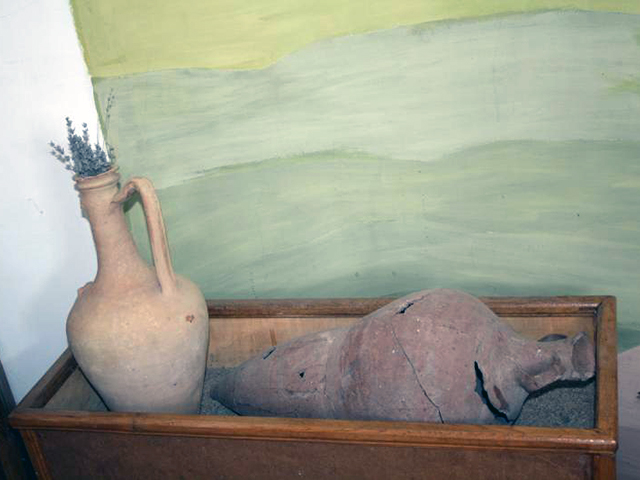 In the times of the Soviet Union near the ancient settlement was built an observation point of the Black Sea Fleet. When the development of military technology and missile defense systems removed the strategic importance of the point at Kara-Tobe, archaeologists were allowed here. Since 1963, they have been slowly, layer by layer, removing cultural layers and bringing to the surface new surprising facts about the history of western Crimea.
To date, members of the society «Evpatorion» achieved that the settlement of Kara-Tobe was included in the list of attractions of Ukraine and recognized as an archaeological monument. Since 2002, an international center engaged in experimental archaeology has been working here. As part of the project, a Scythian village is being built and a summer health camp for teenagers interested in history has been created. So while vacation in Saki recuperates parents, their children can spend amazing days immersed in the life and culture of the ancient peoples of Crimea.