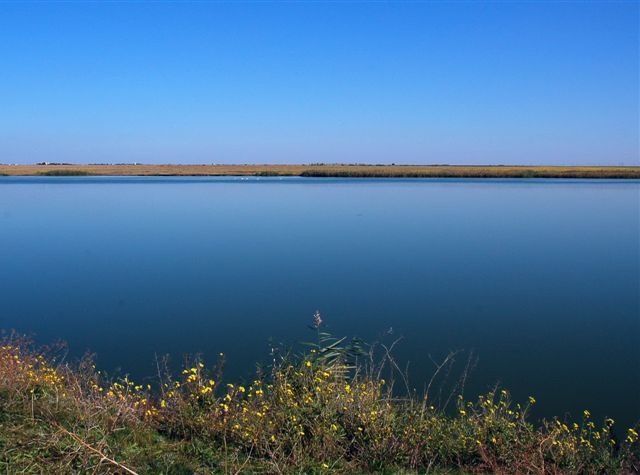
 Lake Donuzlav was connected to the Black Sea by an inlet channel in 1961, effectively turning Lake Donuzlav into a bay of the Black Sea. However, even today the traditional name of Donuzlav Lake remains. Among the lakes of the Tarkhankut group Donuzlav is the largest and deepest lake in Crimea and Europe.
Lake Donuzlav is unique due to its configuration of size and geomorphology, as well as the composition of flora and fauna of the ecosystem. Lake Donuzlav stretches from southwest to northeast. The bay is characterized by a narrow natural fairway in the middle part of Donuzlav. The area of Lake Donuzlav exceeds 48 square kilometers, length — 27 kilometers, width in the upper part of Lake Donuzlav and the middle part is about a kilometer, in some places up to 500 meters, in the lower part — 5-6 kilometers and only at the embankment the width of Lake Donuzlav increases to 10 kilometers. The shoreline of Lake Donuzlav is strongly indented, forming numerous bays and coves. 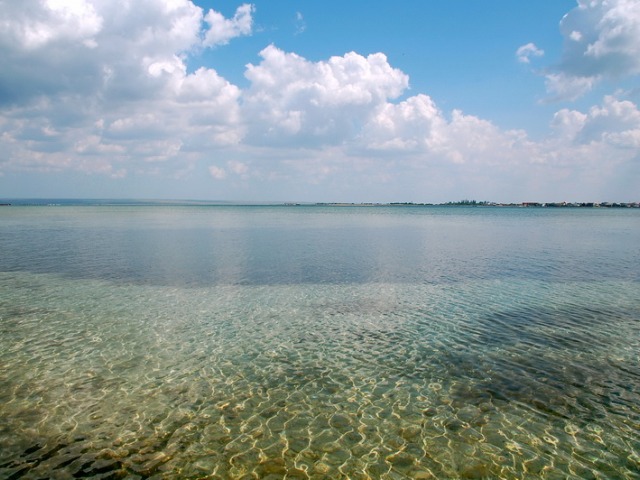 The overwhelming part of the Donuzlav Bay water area is shallow water with depths up to three meters. Along the axial part of Donuzlav Bay there is a navigable channel with depths of 10-12 meters Depths in some hollows of Donuzlav Lake exceed 20, the maximum depth of the lake is 28 meters.
Due to the spatial location of Donuzlav Bay and peculiarities of the wind rose in the region, intensive water exchange between the Black Sea and Donuzlav Bay is achieved. Winds from the southern component have average speeds of 1 to 5 meters per second and higher frequency of occurrence than winds from the northern direction, with average speeds of up to 6-8 meters per second typical of the northern winds. A sharp change of wind direction by 180 degrees within 0.5-1 hour was often observed. In most parts of Donuzlav Bay water salinity does not differ from sea water in the Black Sea and ranges from 17.9 to 18.2%. In places where underground spring water comes out in Donuzlav Bay, and also as a result of spring snow melting and flooding in Donuzlav Bay, areas of fresh water are formed
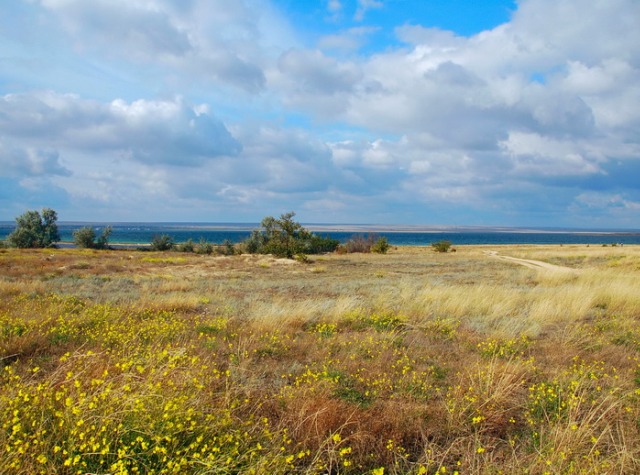 Lake DonuzlavThe modern flora and fauna of Donuzlav Bay is characterized by a wide species diversity and includes freshwater marine and brackish-water organisms. In Donuzlav Bay there is reproduction, feeding and wintering of such valuable commercial species as mullet, sturgeon, herring flounder, mussels, Black Sea shrimp and other species Ichthyofauna of Donuzlav Bay includes some fish species listed in the Red Book; in total there are at least 52 species from 30 families, of which 30 species are local or sedentary; and 22 species are migrants.
According to the results of scientific research Lake Donuzlav is characterized by a high level of biological productivity and is one of the most promising bodies of water in the Crimea for the organization of farms for the cultivation of algae, invertebrates and of course fish. Preliminary experiments on artificial breeding of giant oyster in Donuzlav Bay or Black Sea mussels had positive results. 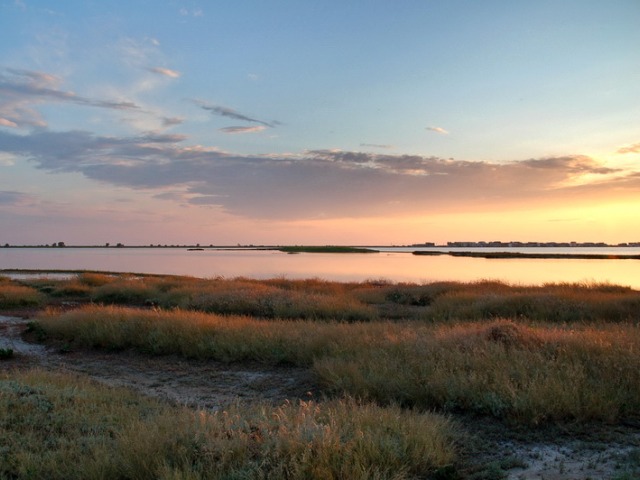 The scientists have calculated and evaluated the potential capacity of Donuzlav Bay with regard to mullet-pilengas and plaice-glossa as a commercial product, which, in case of breeding mullet and plaice will be, according to preliminary estimates, about one and a half thousand tons per year.
Besides fishery development of Lake Donuzlav, recreation on Donuzlav and development of Donuzlav resort infrastructure will improve the environmental and economic situation in the Donuzlav region Development of the coast should give the opportunity to regenerate the local flora and fauna, and also take into account the wind rose for the development of water sports on Lake Donuzlav, for example, such as kitesurfing.