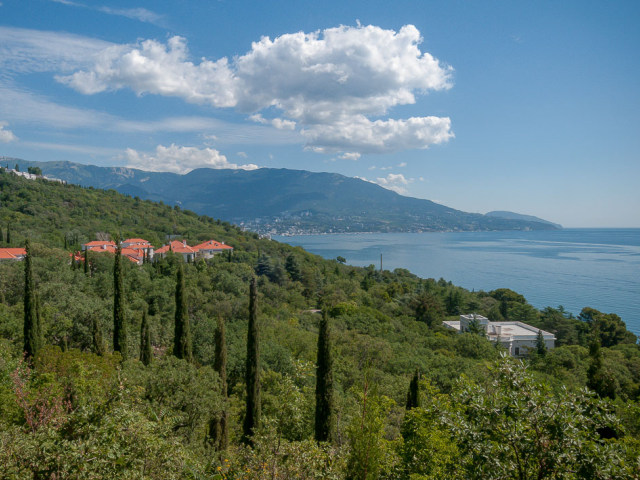
 The former Grand Ducal estate of Oreanda is located near Yalta, south of Livadia, from where Solnechnaya trail, which appeared in 1861 and was called Tsarskaya. The Sunny Trail offers a wonderful view of the surrounding area. Oreanda is characterized by rocky landscapes: the Mast Rock stands near the sea, not far from it is the Cross Rock, and above them proudly raised their heads mountains Ai-Nikola, Belogolovaya and wild cliff Khachla-Kayasy. Steep cliffs, deep ravines, azure sea created a unique beauty of these places.
Once there was a Greek settlement on the place of Oreanda. The remains of a medieval feudal castle and a small Christian temple at the edge of the cliff are preserved on the Krestovaya Mountain.
In 1852 in Oreanda was completed construction of a luxurious royal residence of Nicholas I, designed by A. I. Shtakenshneider, surrounded by a beautiful park. After the death of the tsar, the palace was inherited by his second son Konstantin Nikolaevich, who loved these places very much. But in 1882 the palace burned down, as it was established by the investigation «due to careless handling of cigarettes by the children of the yard clerks.
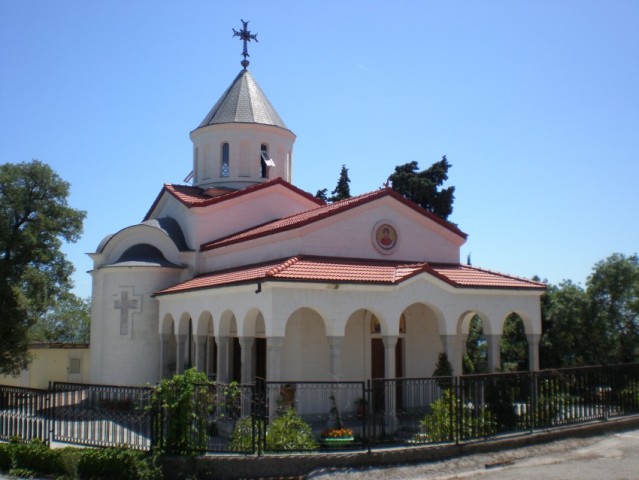 The Grand Duke himself chose the place for the future church. During the solemn laying of the church, a plaque with the following text was placed at the base of its foundation: «In the name of the Father, the Son and the Holy Spirit: by the diligence and zeal of the owner of Orianda, His Imperial Highness the Sovereign Grand Duke Konstantin Nikolaevich, this church is being built in memory of the Feast of the Protection of the Most Holy Mother of God. April 31 days of 1884 in the summer of III RH. Amen». The name of a temple the Grand Duke too has chosen itself, in honor of the favorite holiday.
Konstantin Nikolaevich was a well-educated man, well versed in architecture. He planned to build the temple in the Georgian-Byzantine style, which, in his opinion, best suited the harsh, rocky terrain of Oreanda.
The project was developed by the famous architect A. Avdeev. It was decided to build the church not far from the Admiral’s House, which was surrounded by large oak trees. To orient the apse of the temple strictly to the east, it was necessary to cut down several trees. But the Grand Duke wished to keep the mighty giants, therefore the altar of a temple is turned a little to the south-east.
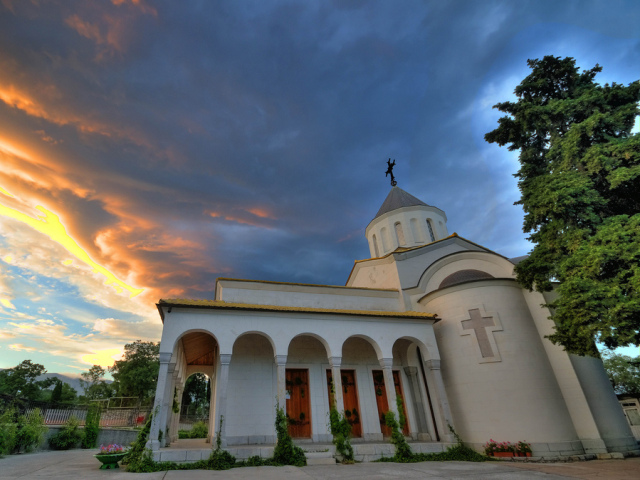 The stones from which the palace was built were used for construction. The temple turned out to be small, cross-shaped, with one dome with narrow arched window openings in the light drum. The dome was crowned with a Byzantine, openwork, bronze-gilded cross. On three sides of the temple is framed by an arched gallery. The outer walls are decorated with large crosses made in Livorno from white Carrara marble. The temple did not have a bell tower. A kind of belfry was built from the oak tree growing nearby, where a wooden ladder was arranged, a platform of two boards and hung five bells, the largest of which weighed 160 kilograms, and the smallest — 3 kilograms.
Pokrovskaya Church was characterized by rich decoration. Part of the temple was painted by famous artists: D. I. Grimm, academician M. V. Vasiliev, vice-president of the Imperial Academy of Arts, Prince G. G. Gagarin. G. Gagarin, from whose drawings the Italian master Antonio Salviati created two mosaic icons of the Savior and the Protection of the Blessed Virgin Mary, placed above the porch and the high place of the temple, respectively.
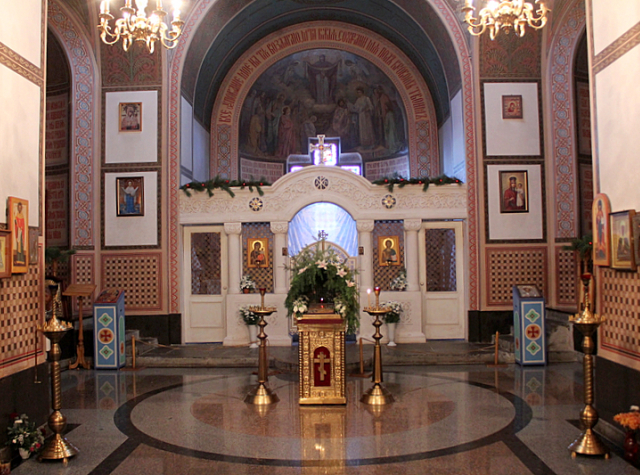 The walls, dome and sails of the temple were also decorated with mosaics. The carved iconostasis was made of walnut, oak, cypress and juniper by master Kubyshko. Yellow-orange glass filled the temple with soft sunlight.
The solemn lighting of the Church of the Intercession of the Most Holy Mother of God took place in 1885. This church became the favorite child of Prince Konstantin Nikolaevich.
The new Emperor Nicholas II with his family came to the Church of the Intercession on church holidays, liked to walk in the local park, admire the beauty of the rocks, reflect on the seashore.
The temple in Oreanda visited AP Chekhov. The heroes of his story «Lady with a Dog» — Gurov and Anna Sergeevna — here they reflected on eternity and life.
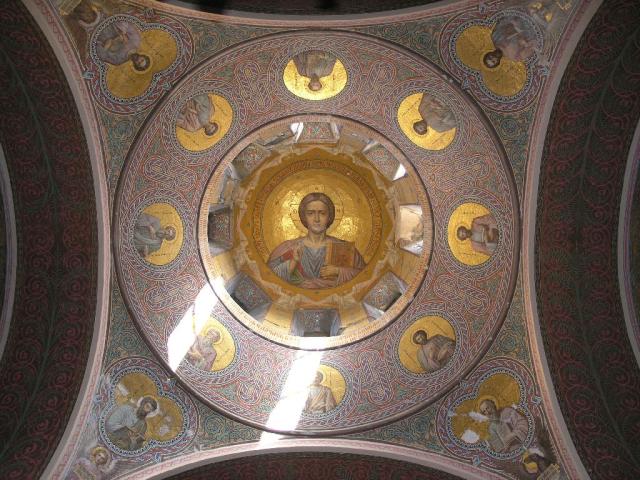 After the revolution the church experienced many difficult days and was almost destroyed. The church was closed in 1924. It was transferred to the jurisdiction of OHRIS (Committee for Museums and Protection of Monuments of Art, Antiquity, Folk Life and Nature), and then to the Management Livadia Palace. Excursionists came to see the wonderful mosaic frescoes. In 1927 the church building was slightly damaged by an earthquake, in the altar part there was a crack, but nobody repaired it. They tried to throw the cross from the church, but could not tear it off, it broke at the base. A part of this cross is now kept in the church as a precious relic.
After the war, construction of a sanatorium began in Oreanda. Obviously, the small church, in the opinion of the architects, did not fit into the modern look of Oreanda. Therefore, in the early 60-ies it was decided to demolish it. However, for the temple vtsupivlyaetsya local historians. They achieved that the temple was recognized as an architectural monument. More than 30 years here stored toxic chemicals, and in the churchyard was located in the automobile depot.
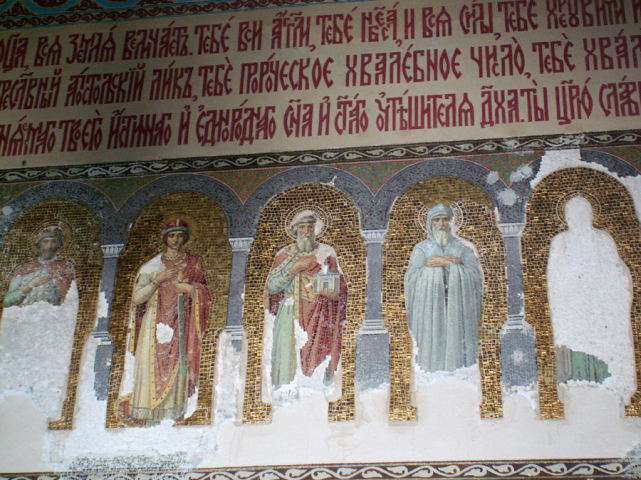 The building was badly damaged by landslides and required restoration, which began in 1992 after the temple was returned to the Orthodox Church in 1992 for the Feast of the Annunciation of the Blessed Virgin Mary. The parishioners put the church in order, and on the Feast of the Holy Trinity, for the first time in many years, the Divine Liturgy was served there.
In 2001 a bell tower was built next to the church. In Donetsk at LLC «Korner-M» cast a beautiful bell weighing 603 kilograms. To make the voice of the bell sound beautiful, during its manufacture they used a stove, the fire in which was supported by wood. The bell is decorated with four stamps, which depict the Lord Supreme, the Protection of the Blessed Virgin Mary, St. Nicholas the Wonderworker and the Great Martyr and Healer Panteleimon. On the roof of the belfry was installed an openwork cross made by the Kiev artist Oleg Radzevich. The Yalta charity fund «Hope» provided great assistance in the creation of the cross.