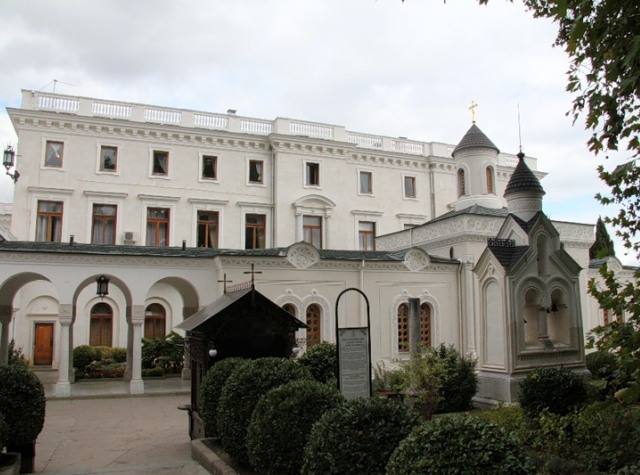
Just a few kilometers from Yalta is the resort village of Livadia. In 1860 the Appanage Department bought the estate of Count L.P.Pototsky to build a palace here. Emperor Alexander II gave Livadia to his wife Empress Maria Feodorovna, who was ill with consumption and had to be annually treated in the south.
The court architect Ippolit Monighetti (1819-1878) was commissioned to build an architectural complex here: two palaces, service premises, greenhouses, swimming pools and, of course, the palace house church. The church was converted by the architect in 1864 from a church, so its altar is oriented not to the east, as in all Orthodox churches, but to the south.
Monighetti created the church in Byzantine style, modeled after the ancient Greek church of St. Luke, once built in the village of Livadia in Greece. The Church of the Exaltation of the Cross is small, as it was designed for the imperial family and the immediate entourage. In plan, the building is a cross, stretching from north to south. Above the church rises the dome on a slender light drum. Later it was dismantled, and now we see a new small drum topped with a cross.
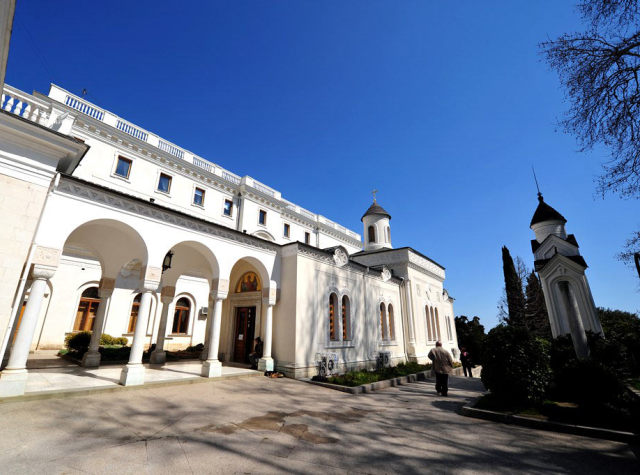
The east wall is cut through with arched windows — paired and triple. Monighetti used ornamentation in the style of Transcaucasian architecture in the design of the temple. The church is decorated with platbands around the windows and a wide band under the roof.
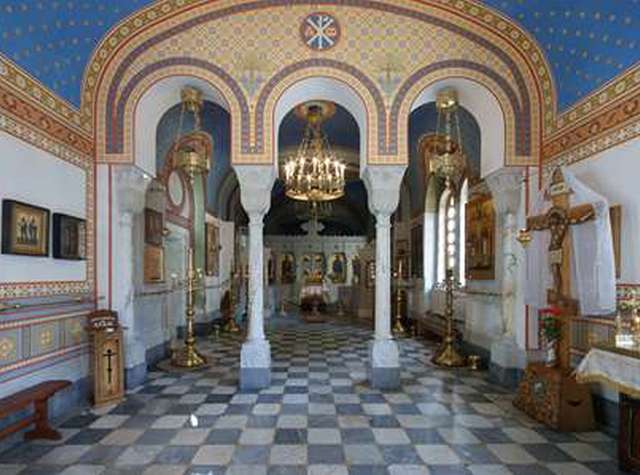
The interior of the church was also created in Byzantine style by artist Izello based on Monighetti’s drawings. Icons for the church were painted by the famous artist Academician Alexei Beydeman. For his work he was awarded the Order of St. Stanislaus of the 2nd degree. The iconostasis made of white marble became a special decoration of the church. The king’s gate and altar doors were made of carved bronze. On both sides of the iconostasis were two walnut analoes: one was occupied by a temple icon, the other — an ancient image with parts of holy relics, it was decorated with precious stones. This image was a gift to the Romanovs from the Georgian kings. There were beautiful silver candlesticks in front of the iconostasis.
The vault of the church was painted in blue color and dotted with golden stars. A small chandelier descended from the middle of the church. A small door led from the church to the sacristy, and from there to the study of Alexander III.
At the request of Empress Maria Alexandrovna, the church was consecrated in honor of one of the most revered feasts of the Exaltation of the Holy and Life-Giving Cross of the Lord.
A belfry was built next to the church according to the project of D.I.Grimm, it is decorated with ornaments, which were carved from stone by a talented craftsman T.A.Kostikov, a peasant from Orel province. During the reign of Alexander Sh, a marble column from the fortress of Rushchuk on the Danube was placed here in 1879 to commemorate the Russian-Turkish campaign of 1877-78, when Russia fought for the liberation of Bulgaria from the Turkish yoke.
One day rain moisture got into the temple through a leaky roof and spoiled the main icon of the Exaltation of the Honorable Cross. It was decided to replace it with a mosaic. Academician A.N.Popov made an exact copy of the icon on cardboard for the firm A.Salviati, which was entrusted to perform the work. The work was done in 1888 and has survived to this day.
When the palace was rebuilt in 1910-1911, the architect N.P.Krasnov preserved the church building, making minor changes. He enlarged the side chapel, having built an entrance here. The previous entrance led to a semi-open gallery connecting the church with the palace. Krasnov turned this gallery into a fully closed. The portal of the temple was decorated with a mosaic icon of the Archangel Gabriel. It was made in the workshop of Professor P.P.Chistyakov. He also painted the narthex, among the icons was the icon of the Mother of God Fyodorovskaya.
Important events for the royal family were performed in the Livadia temple. In 1894, Emperor Alexander III passed away. The memorial service for the deceased sovereign and the oath of the new Russian Emperor Nicholas II took place in the palace temple. Here also St. Righteous John of Kronstadt anointed Nicholas’ bride Princess Alice of Hesse, she became the Orthodox Princess Alexandra Feodorovna.
After the establishment of Soviet power, a sanatorium for peasants was opened in Livadija. The church was closed, for many years of neglect here was organized and a club, and warehouse, and museum space. In those days, only the mosaic image of the Archangel Gabriel above the main entrance and the belfry standing next to it reminded us that this had once been the House of God.
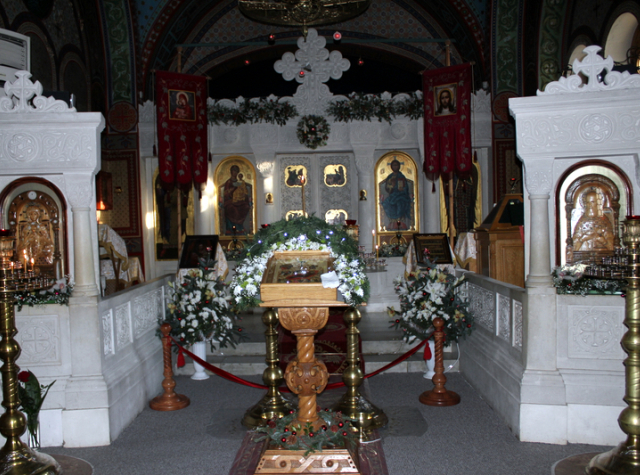
The iconostasis and marble facing of the walls were not preserved in the church, instead the panels were painted with marble paint under gray marble. Only the mosaic panel on the subject of the Exaltation of the Holy Cross shone with undying light.
In 1991, the church resumed services. Revival of the temple went slowly: the iconostasis was first plywood, then appeared an oak lectern, which reproduced the carving of the marble frame of the old doors. To the left and right of the altar stood oak carved caskets for the main icons: the Mother of God «Derzhavnaya» and St. John of Kronstadt.