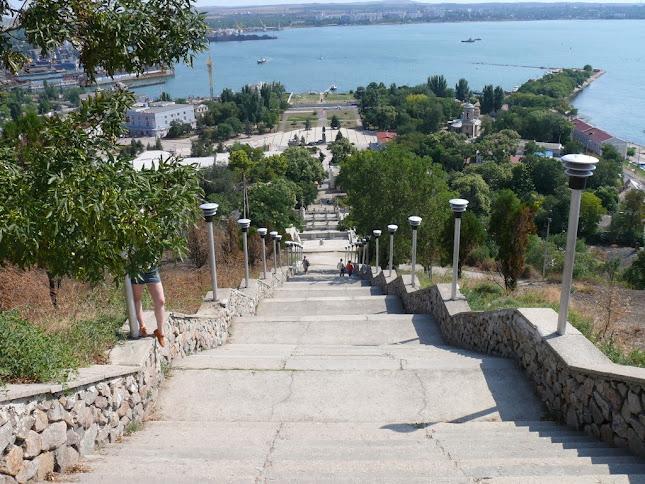
 Ancient Kerch has experienced several eras over thousands of years of its existence, the memory of which is still preserved by its architecture. The Grand Mytridat Staircase is Kerch’s landmark, a reminder of its rich history, heritage and distant past. It is one of the most visited places by tourists, and for the residents of the city it is one of the most favorite places to walk.
The Mithridates Staircase was erected on Mount Mithridates in 1833-1840, designed by the talented Italian-born architect Alexander Digby. The soul of the project was the original concept of «connection of times», created by the architect together with other admirers of antiquity: Russian Kerch, thanks to the architectural complex in classical traditions created on Mount Mithridates, was to become the successor of the culture and rich past of the ancient city. Digby decided to make the staircase the center of this complex, which is also symbolic.
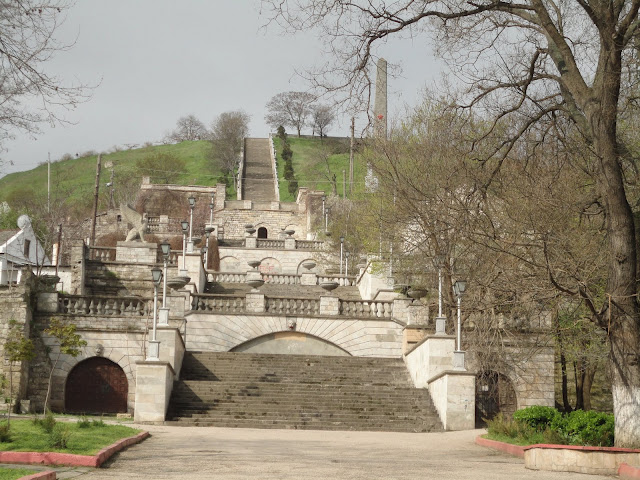 The staircase leads from the central square of Kerch (Lenin Square) to the very top of Mount Mithridat. Several of its tiers are formed by 432 steps, the tiers are connected by beautiful observation platforms, from which as you approach the top of the mountain gradually opens a magnificent panorama of the city and Kerch Bay. No less impressive view opens from the sea and the square and on the Mithridates staircase itself. For this purpose, Digby used an interesting architectural technique in designing the staircase: so that the long length of the mountain slope would not cause a strong visual reduction in its width, the staircase was designed according to the principle of reverse perspective — that is, its tiers successively expand from the base to the top.
The viewing platforms connecting the tiers of the Mithridates Staircase are decorated with figures of the city symbols — griffins, as well as stone vases. The most lush and richly decorated architect made the platform of the first tier, building it in the form of several terraces with elegant railings. Thanks to this, if you look at the staircase from below, it seems incredibly beautiful and especially solemn.
The griffins decorating the staircase were not chosen by Digby by chance — these mythical creatures with a lion’s torso, eagle’s head and wings and a snake’s tail are reminiscent of the Scythians who lived here in pre-Greek times. In myths, griffins acted as guardians protecting treasures and, in a more philosophical sense, hidden and secret knowledge.
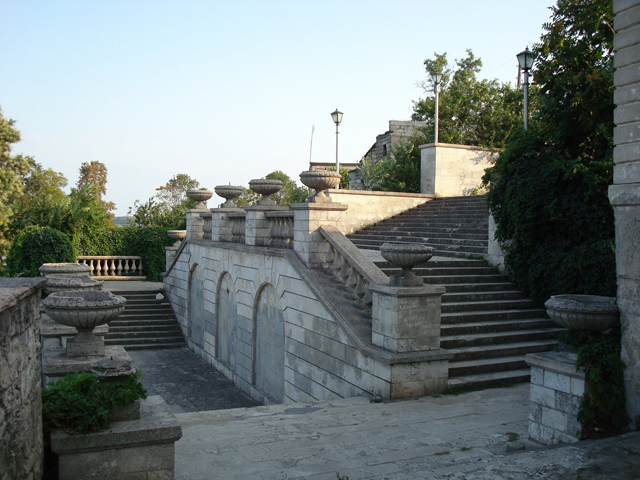 The bright stone staircase in the style of classicism, leading to the top of Mount Mithridates, immediately after the completion of construction became one of the main symbols of Kerch. Unfortunately, during the Crimean War it was partially damaged, but 130 years later the appearance of this attraction of Crimea was fully restored under the guidance of Kerch sculptor R.V. Serdyuk, and today it can be seen as it was before the middle of the XIX century.
The Grand Mithridates Staircase is all that has survived from the complex that was erected under the direction of A. Digby on Mount Mithridates in accordance with the idea of «connection of times». On its top is no longer seen reminiscent of the Athenian temple of Theseus building Museum of Antiquities, the chapel-mausoleum IA Stempkovsky, but the Mithridates staircase still perfectly conveys the genius of the architect. This is a magnificent, beautiful structure, in the brightest colors reflecting the rich historical heritage of Kerch. For all those who spend their holiday in Kerch, climbing to the top of Mount Mithridates on the 432nd steps of the staircase will be an exciting event that will leave a lot of pleasant emotions and memories.