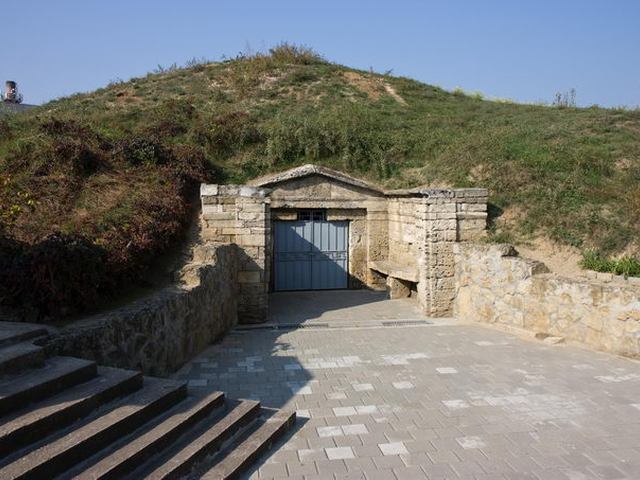
Among the many investigated Bosporan stepped crypts, the Melek-Chesmen barrow has gone down in history as the most technically and artistically perfect among the Bosporan stepped crypts. The mound got its name from the Tatar name of the Melek-Chesme river flowing nearby.
Here is how the excavations of the mound is described by its researcher, director of the Kerch Museum A.E. Lyutsenko: «Of all the adjacent to the city itself, grave mounds, this is the most enormous. Pits disfiguring it everywhere, especially from the sides, show that it has already been repeatedly taken to excavate for search. The inhabitants of the city and the suburbs, constantly mining clay here, even in recent times, at the foot of the discovered various kinds of tombs, which, for the most part, turned out to be ruined. In general, it can be seen that it served as a cemetery afterwards.
In 1857, discovered on the southern side of the mound, detachments of building stone forced to make a small excavation to explain their origin. For various reasons it was left unfinished. Now it was decided to continue, following the direction of the impressions.»
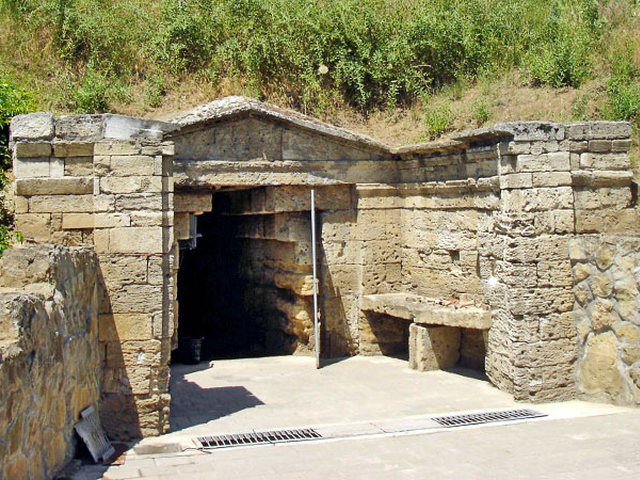
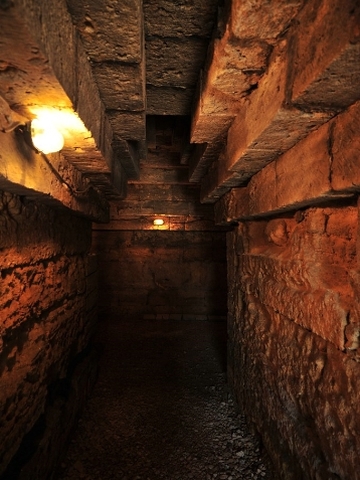
Excavations at the time were carried out by long trenches cutting through the mound. Following the trenches leading to the middle of the mound the researchers in the evening of December 13, 1858 came across a stone wall made of huge hewn slabs of local limestone. «In the morning, having ascertained that the wall was perfectly inviolable, two slabs were removed from it, so carefully that they did not in any way damage the general connection of the structure. Behind them was an empty space. Entering it, and illuminating it with fire, they saw a long vestibule of Egyptian architecture. At one end of it, eastward, was a large pyramidal crypt, and at the other, westward, was an outer entrance, all covered with slabs.
The neatness on the stone platform of the vestibule, the perfect integrity of the walls and vault everywhere, all gave hope that this majestic tomb had been preserved inviolably. But the hope was not realized. The crypt had been ransacked. In the north-west corner of the crypt were found the remains of a child near them, four square stones and some planks from a child’s coffin. Here and there on the floor there were shards of alabaster and between them one bronze bracelet, ending with gold snakes with enamel scales. The absence of one slab in the ceiling, at the very entrance, explained afterward the way in which the searchers had penetrated here. There is no data to determine the time when the tomb was destroyed.
In the southwestern part of the mound was found a part of the fence made of one row of roughly hewn limestone slabs. A cremation site was discovered on the northern side. Fragments of broken crockery and copper nails from a burnt coffin were found together with burned human bones. The fragments belonged to two red-figure vessels. One of them is a patera (drinking vessel), where seven figures in a solemn procession were depicted. The relief part of the figures retained traces of gilding. The second vessel — vase depicted a battle of griffins. According to the style of painting they are dated 40-30 years IV century BC (BC). In fact, this vessel served as the basis for dating the mound itself.
In June 1863, a limestone tombstone stele was found on the northern side of the mound with a relief and epitaph in ancient Greek «Ma, mother-in-law of Iosar, farewell». The relief shows a woman dressed in a long chiton and a cloak thrown over her head. On the right is a servant figure with a pixida (a round box for ointments or jewelry) in her hands. This stele belongs to one of the later burials made in the mound. According to the nature of the writing, the stele is dated to the 1st century BC. It is interesting to note that the mention of the mother-in-law was found for the first time and is not recorded anywhere else.
Often, mounds that were poured for one tomb were turned into a cemetery for subsequent generations. The Melekchesmen kurgan was no exception. Burials were made there even 500 years after its construction.
Odessa Society of History and Antiquities on the initiative of the secretary of the Society N.P. Murzakevich began to vigorously clamor for the preservation of the mound. «All stone work in this crypt, worth 600 rubles, made at his own expense Kerch Honorable Citizen Konstantinov, as allocated for this subject for 1871 300 rubles barely reached for excavation work and the hiring of a watchman».
With the help of brought earth mound was given the former cone-shaped appearance and in July 1871 the mound was opened to the public.
Soon tombstones and other finds found during the excavations began to be stored in the chamber of the mound, which formed the basis of the new Melek-Chesmensky Museum. Along with the archaeological museum, the Melek-Chesmen Museum was the most visited.
Who and when was buried in this mound? This question can be answered only approximately. The grandiosity of the construction of the mound, the perfection of the burial chamber testify that the buried belonged to the top of the Bosporan society and, quite possibly, to the royal family of the Spartokid dynasty ruling in the IV century. Fragments of black-lacquer pottery found in the mound (in particular, fragments of two red-figure vessels, among which there is a lekana lid with the image of Aphrodite, Dionysus among Erotes dated 325-290 BC) allow us to attribute the burial to the second half of the IV century BC.
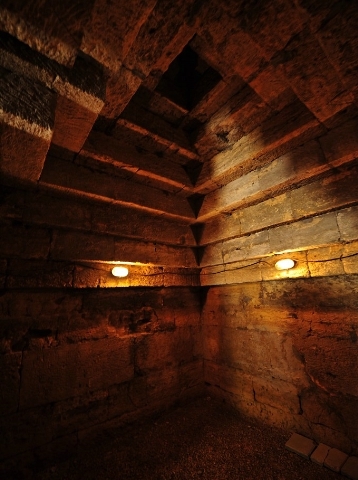
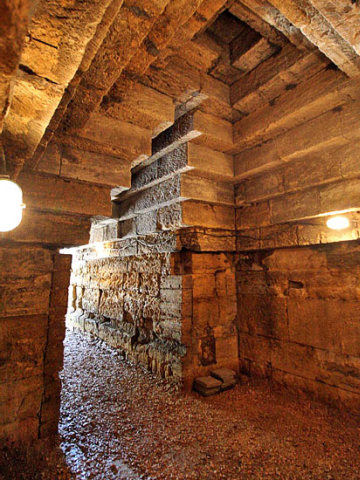
The stepped crypts, whose vaults and domes are overlapped by overlapping rows of masonry, are the earliest and most architecturally interesting monumental tomb monuments of the Bosporus. At the time of the excavations, the mound was 12 meters high and 200 meters in circumference. The long, nine-meter long dromos leading to the tomb with a stepped floor is masterfully connected to the square burial chamber (3.7×3.7 meters), which is covered with a pyramidal vault with 7 ledges on each side. The vault starts exactly at half the height of the crypt. Approaching the top from all four sides, the rows converge and are covered with one slab lying horizontally. The steep walls rise in five rows of slabs.
The walls of the dromos are the same height as the wall of the crypt and likewise consist of five rows of slabs, while the vault consists of only three rows. Thirteen slabs close the vault from above. The last of them at the entrance, as noted above, was missing.
The floor is everywhere lined with slabs, which lie on the mainland buffered with rubble. In the crypt the floor is somewhat raised. The outer entrance was laid with huge stones rising in seven rows. In the longitudinal walls of the dromos horizontal recesses were made, in which rotted wooden posts were found. The connection of the pyramidal vault with the prismatic vault of the dromos below required a special art.
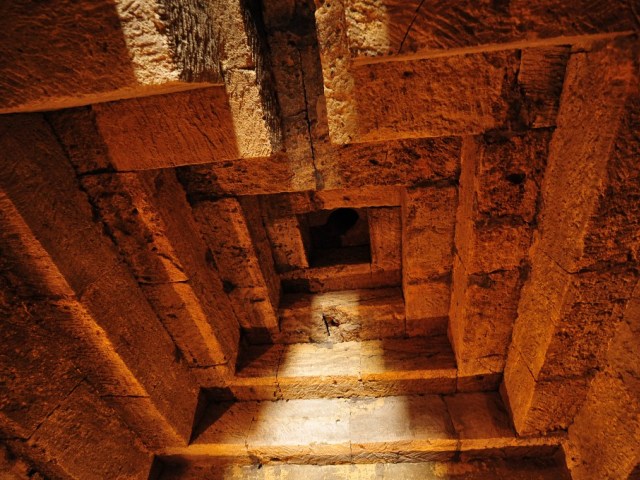
The portal with antes attached to the dromos is topped by a pediment. This is the only known case of such a vault design in the European Bosporus.
With the advent of Soviet power Melek-Chesmensky barrow was transferred to the Kerch Museum.
During World War II, at the initiative of the museum director, a marble sarcophagus discovered in the Lysaya Gora barrow near Taman was transported from the ruined Taman Museum. The sarcophagus, weighing almost 5 tons, was made in Greece in the form of a temple with a double-sloped roof and was installed in the crypt of Melek-Chesmensky barrow, but during the retreat it was broken into small pieces. The sarcophagus has now been restored and is in the Historical Museum in Moscow.
The present reconstruction of the barrow was carried out in 1994.