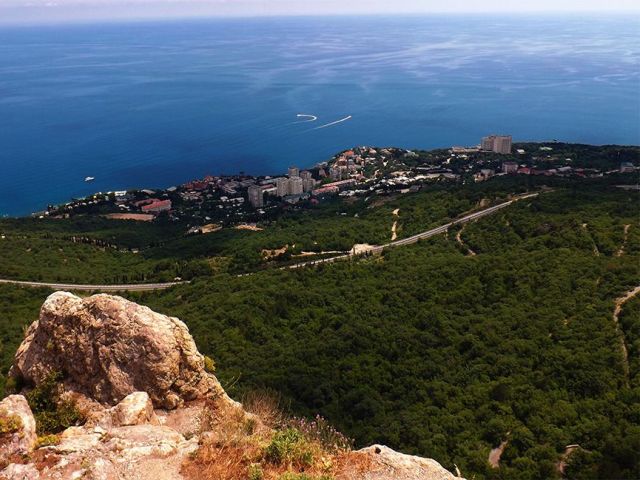
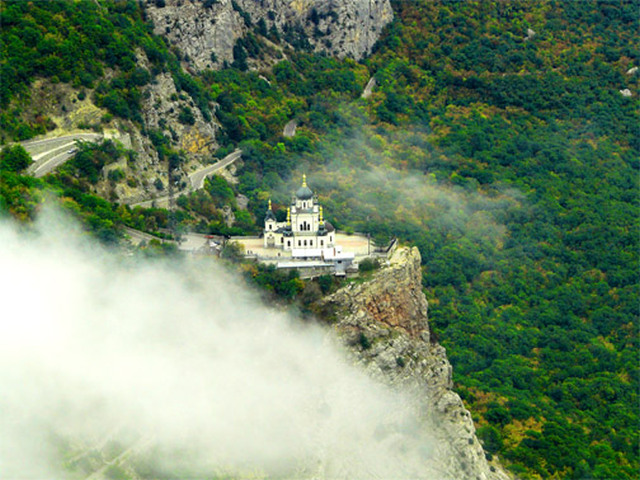
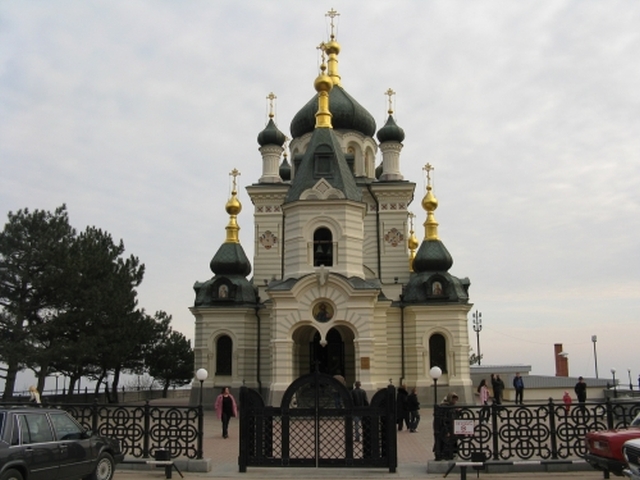
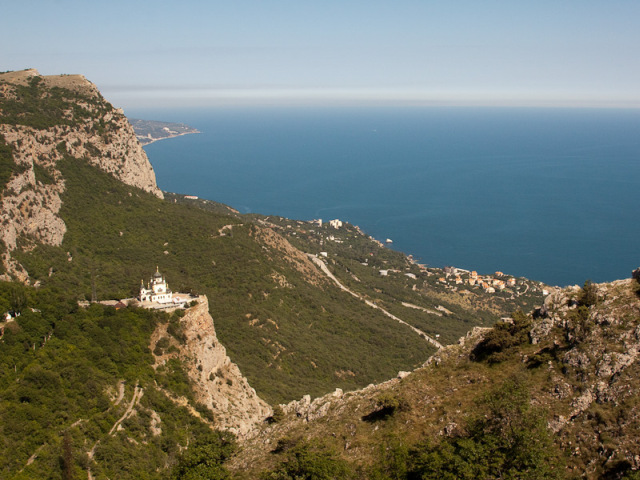
Foros, whose name comes from the Greek word for «tribute», «toll», is a resort village on the southern coast of Crimea. Not far from it is located the dacha of the first president of the former USSR M.S.Gorbachev. But in recent years, many people come to Foros in order to see and pray in the Christ Ascension Temple, which rose on the most picturesque place (427 meters above sea level). It would be difficult to choose such a good place for this church: the red mountain, separated from the main massif of mountains, surrounded by dense green forest, down there is a gray ribbon road, and further — the vast expanse of the sea. It is visible from everywhere — from below from the sea and from above from Yayla.
After the opening of the road linking Yalta and Sevastopol in 1848, the coastal plots were quickly bought by wealthy people. In the western part of the present Foros already in the 20s of the nineteenth century was located Tesseli estate, which was granted to General Raevsky, the hero of the Patriotic War of 1812.
It was he who laid the Forossky Park, a monument of landscape architecture. Later the estate was bought by a famous tea manufacturer, Moscow merchant of the first guild Alexander Grirorievich Kuznetsov (1855-1895). He built a mansion in the style of Russian classicism, which became not just a house, but a temple of art and creativity. Writers, artists and musicians often visited here: F. Chaliapin’s voice sounded under the roof, S. Rachmaninoff played in the spacious hall, A. Gorky and A. Chekhov worked on their works. The interior elements of Kuznetsov’s house have been preserved to this day: fireplaces, Italian parquet, an ancient musical instrument and a real jewel — 16 wall panels painted by the artist Julius Klever.
The Foros Church was also erected at the expense of A. Kuznetsov.
 .
.
Many legends are connected with the appearance of the church on the red mountain. One of them tells that the young daughter of a merchant (according to another version his beloved) was riding in the mountains. Suddenly the horses, as if afraid of something. Carriage carried straight into the abyss. But at the very edge of the cliff horses stopped, as if in front of an invisible barrier. A church was built in honor of the miraculous rescue.
Archival documents record a different version of the appearance of the temple, but it is also connected with a miracle. On October 17, 1888 at the station Borki on the Kharkov railroad there was a crash of the tsar’s train. The royal family, returning from Yalta to St. Petersburg, remained unharmed. In memory of the miraculous rescue of Emperor Alexander III and was erected the Church of the Resurrection of Christ. It is assumed that on the part of Kuznetsov this church was a kind of payoff, as the breeding and sale of tea was considered a monopoly of the royal family.
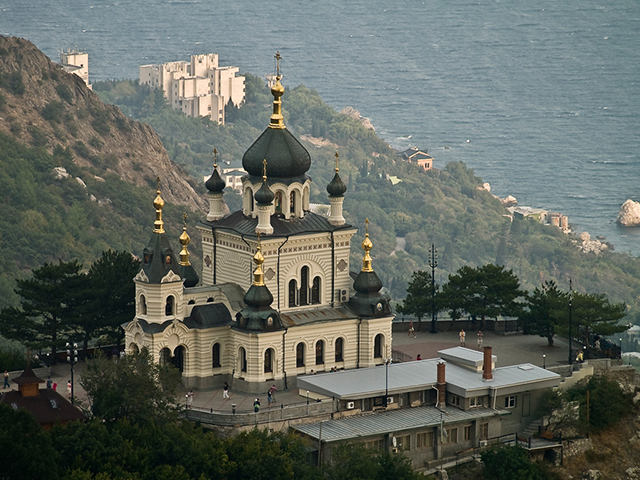
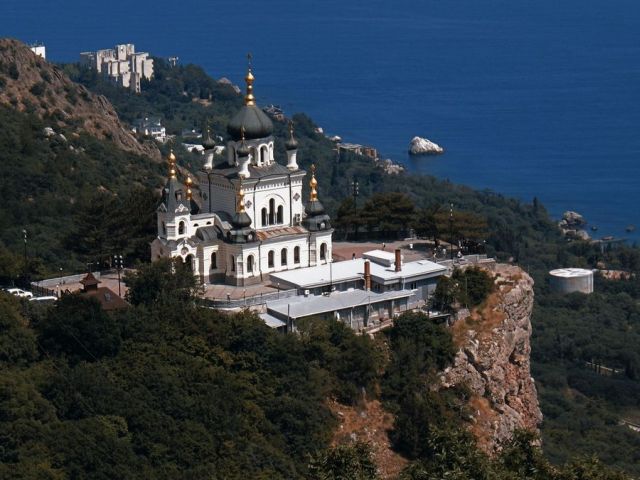
The project was designed by Russian architect Academician N.M.Chagin in 1888. The church was built in Byzantine (Russian) style in two tiers, on the sides and in the center — nine domes of different sizes. During the construction of the temple used a special technique of laying flat brick — plinfa, the walls are faced with white Inkerman stone. The temple is decorated with a patterned porch with a bell tower with gilded crosses. Columns with different capitals, panels and window sills were made of Kararr marble. The floor was decorated with mosaics by the famous Italian master Antonio Salviati.
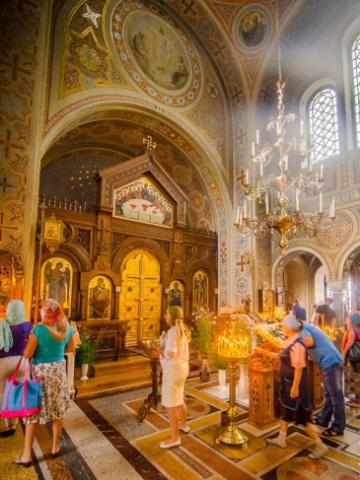
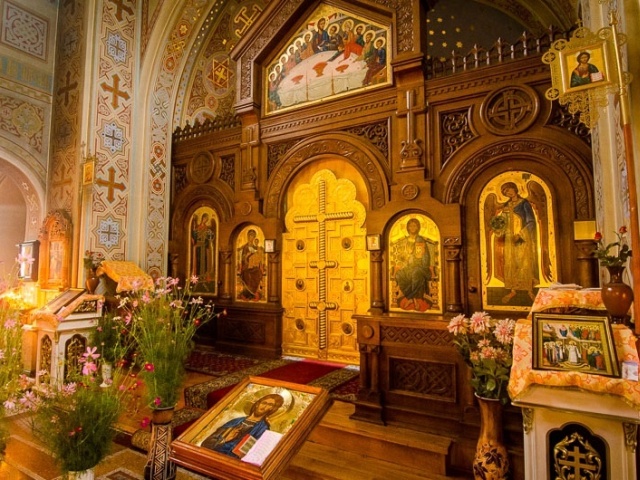
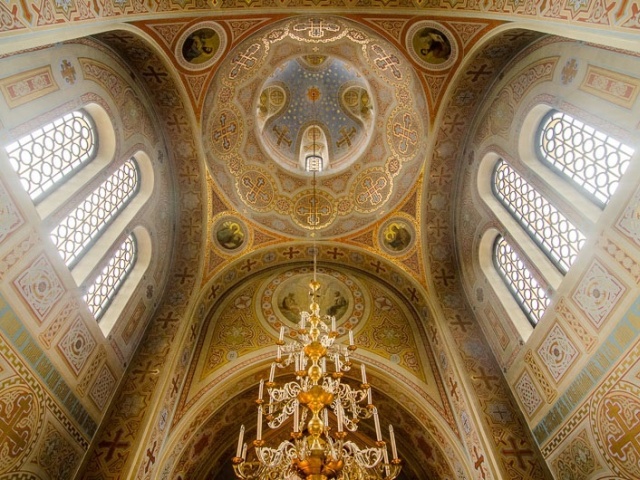
In the interior of the church the carved oak iconostasis with gilded Royal Gates attracted attention. The icons for the church were painted by famous Russian painters: A. Korzukhin, academician E. Sverchkov, the icon of the Nativity of Christ belongs to the brush of K. Makovsky. The walls of the temple were painted with Byzantine ornament.
 .
.
In 1892 the church was consecrated by Bishop Martinian of Tauris in the glory of the Ascension of Christ. The service was attended by the chief procurator of the Holy Synod K.P.Pobedonostsev. And six years later, on the tenth anniversary of the miraculous deliverance of Tsar Alexander Sh from death, the church was visited by the Emperor Nicholas II with the Empress Alexandra Feodorovna.
In the ownership of the church A.G.Kuznetsov gave 2.5 dessiatinas of land, on which they built houses for the rector and the parish.
Images of the church were printed on tea cans, which were produced by Kuznetsov’s firm and sold not only in Russia, but also abroad. Over time, Foros Church became a symbol of the South Coast of Crimea.
But above all, the church became a center of spirituality. This was due in no small part to the first rector, Father Pavel Undolsky. He led a great educational work among the population of the surrounding villages. His efforts at the church was opened parochial school, and in the neighboring village of Mukhalatka — a literacy school. For people destitute in Baidarki was created overnight shelter, which was opened a library. It was established by the Yalta Committee of the Trusteeship for People’s Sobriety and was maintained at the expense of the Committee.
Father Pavel was often visited by his friend, A.P. Chekhov, who helped in the construction of a parochial school in Mukhalatka.
After the revolution in the Foros church, standing at a distance, services were held, church life went on as usual. But in 1924 the priest Pavel Undolsky was repressed and exiled (according to other sources he died in his house near the ruined church).
The church was closed and they tried to give it a «civil» appearance: they tore off the crosses and removed the bells from the bell tower. By decision of the commission seized church valuables. Icons by famous masters disappeared without a trace.
In Foros church was arranged warehouse. Years passed. In the villages of Foros, Melass, Mukhalatka began construction of sanatoriums and resorts for dignitaries. In the church building, despite the fact that officially the church was a branch of the local history museum, opened a restaurant.
In 1927 in Crimea there was a strong earthquake, which damaged many houses and palaces, including the famous Swallow’s Nest. But the Foros Church, standing almost on the edge of the cliff, and Kuznetsov’s house were not damaged.
In the 60s a new, more convenient highway was built connecting Yalta with Sevastopol. Foros church was left aside, it became less visited by tourists. The temple gradually deteriorated, and finally it was closed and left to complete destruction.
It was restored and re-consecrated only in 1990.
In 1992 Foros Church celebrated its 100th anniversary. By that time, a team of restorers put new copper domes, shone gilded crosses, finished the interior painting of the altar and the dome of the temple, in the windows inserted colored stained glass.
The Church of the Resurrection of Christ regained the copper bells put by the team of restorers on the belfry. Among them was a bell of 1862 weighing 200 poods. It was kept at the lighthouse of Cape Sarych and was presented to the church by the Black Sea Fleet.
Seventy years later, the church chime sounded again, spilled over the forests, reached the coast, people in the surrounding villages listened to the church chime, raising their heads to the sky.
The church was transformed, made beautiful — all white, bright, as if striving upwards. The church looked especially good in the clear evening, illuminated by powerful spotlights, clearly visible against the background of dark mountains, forest, and starry sky.
Many people began to visit the temple, admire its beauty and wonderful view from the heights, the observation deck near the temple is rarely empty.
Above the church, the old south coast highway goes to the city of Sevastopol through Bajdarskie gate. They offer the best view of the church, as if hovering over the South Bank. And the new highway, very convenient and picturesque goes at the foot of the cliff with the church. The revived Foros Church has rightfully become one of the wonders of the Crimea. From the inside it is as good as from the outside. The walls are painted with floral ornament, through the stained glass pours light. The decoration of the church is undoubtedly the iconostasis. The iconostasis depicts the Mother of God on the left, the sorrowful face of Christ on the right, and the Last Supper above the Royal Gate.