 In the IX-X centuries, ancient Kiev consisted of two territorial districts — the Upper and Lower Towns.
The Upper City — Dytynets, which was the military and administrative center, was located on the Old Kiev Hill. On its territory lived Kiev princes with their cohorts and families.
The Lower City was located on the site of modern Podol, which received its name because of its location at the foot of the Kiev hills on the banks of the Dnieper. This area of ancient Kiev, populated mainly by merchant and craftsmen settlers, grew rapidly due to the presence of a convenient harbor for river and sea vessels. In order to protect it from enemies, Podol was enclosed by a fortified wall of vertically placed close oak logs «little taller than a man», watchtowers were placed along the wall and a moat filled with water was dug. All city buildings were wooden. Podol and the Upper Town were connected with each other by the descent of Borichev Vzvozvoz and the road from St. Sophia’s Gate.
When conducting metro construction works in 1972 at a depth of 10-12 meters archaeologists found log dwellings and outbuildings, wooden fences, sidewalks, products made of birch bark, clay, non-ferrous metals, glass. These historical and architectural finds were dated back to the 10th century.
In all historical times the Lower Town, inhabited by artisans and traders, played an important role in the socio-political and economic life of Kiev. The river harbor on the bank of the Pochaina River received trade flotillas from many countries. Half a century before the adoption of Christianity, the first Christian temple of Kiev — Ilyinskaya Church, which was visited not only by Podolians, but also by foreign Christians. Besides the Christian temple, there was also a pagan temple on Podol — the temple of Veles, the «cattle god».
In the first half of the XII century were built stone Christian churches of the Virgin Mary Pyrogoshcha, Boris and Gleb, Michael. These churches are mentioned by the chronicler in the «Tale of Igor’s Campaign». Prince Igor, who escaped from Cumans captivity, stayed in Pirogošće (the body of the murdered prince is buried in St. Michael’s Church). Pirogošća, which in the XV century was re-consecrated in honor of the Dormition of the Blessed Virgin Mary, has survived to our time. Destroyed in 1935, it was reconstructed in 1997-98.
The first Catholic churches and monasteries were built on Podol in the early 15th century by Dominican monks and Jesuits. In the XV-XVI centuries. trade and craft Podol had many craft shops, which united carpenters, joiners, shoemakers, tailors, potters.
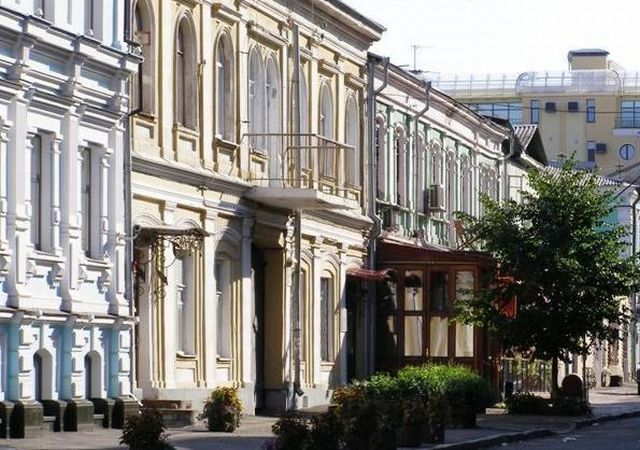
The fire, which occurred on July 9, 1811, destroyed almost all commercial, industrial and residential buildings on Podol. The architect V. I. Geste developed a project for the redevelopment of this part of Kiev, which envisioned straight and wide streets, and in the central part — a large Kontraktovaya Square.
In 1817 the building of the Contract House in the style of classical forms of the Doric order was erected on this square. Built according to the new project, Podol has been almost completely preserved to this day and is an important historical and architectural monument of Kiev. The tourist route, which includes a tour of architectural monuments of Podol, starts from the metro station «Golden Gate».