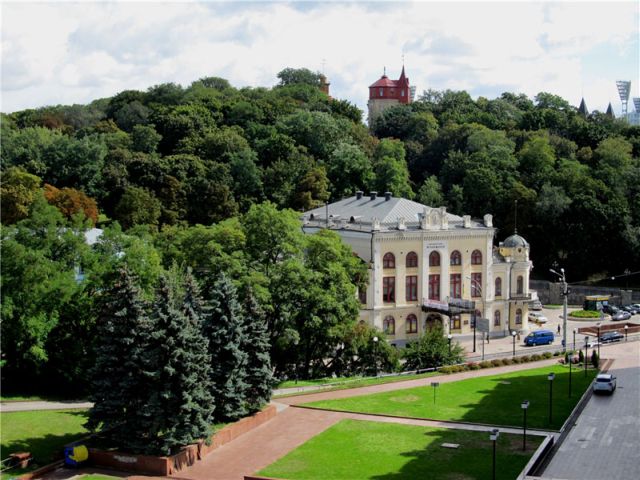
 The appearance of this landmark in Kiev is connected with the name of Russian Empress Elizabeth Petrovna. In 1743, the favorite daughter of Peter I ordered to establish the Tsar’s Park on the slopes of the Dnieper, along the Vladimirsky Descent.
It was the first official place for recreation in Kiev. Firstly, Vladimirsky Descent was the only street in the city paved with stone at that time. Secondly, at the time of the Russian autocrat’s interest in this place, the fortification Skorodum was located here. Expansion of the empire’s borders in the western direction leveled the fortification value of the defense structure. 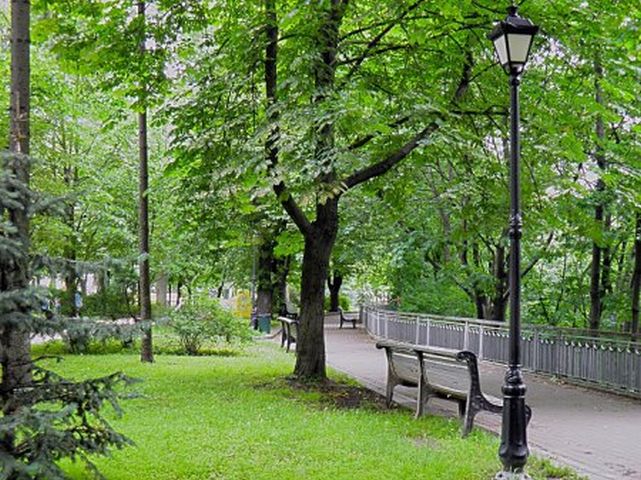 The decision was made to demolish the fort and to build a park in its place. What and began to do in 1752, creating a luxurious royal garden with magical panoramas and a whole host of the best viewing platforms in Kiev.
The primary project of the modern Kreschaty Park assumed that it would be created in the French style. It was it that Elizabeth Petrovna once «implanted» in Russian culture. She spoke excellent French and seriously intended to marry the future Louis XV. 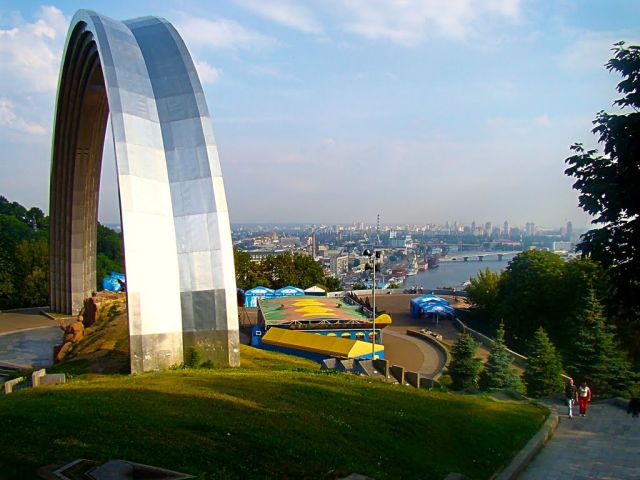 But Gallic motifs and design in the classical regular style hardly fit into the relief of the Dnieper steeps. Therefore, over time, the development of the territory was carried out in the English — «semi-wild» style, in which the design of the landscape maximally corresponded to natural forms.
Taking into account the central location of the cultivated green massif in the growing city, it began to be used for the needs of the population and its individual strata. For example, in 1872 one water tower was built in Tsarsky Park, and in 1876 — the second one. 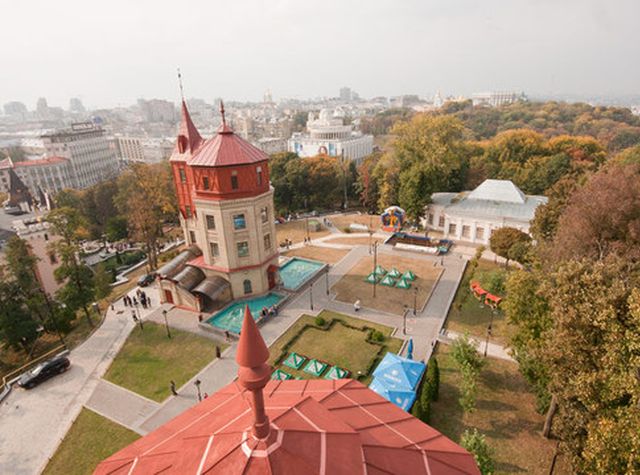 After that in 1882 in the lower part of the Tsarskiy Park the building of the Merchant Assembly was built. Now it houses the National Philharmonic of Ukraine. After that the Tsar’s Garden was renamed to the Merchant’s Garden.
A breakthrough in the recreational plan can be called the appearance of the Park Bridge. The metal construction, designed by Paton, connected the local Petrovskaya Alley with the City Park, expanding the walking zone of Kiev citizens and guests of the capital. In 1910, Park Bridge was put into operation, becoming a champion in several categories at once —  the first bridge structure of its kind, one of the best panoramic sites in the city and a place of pilgrimage for suicides, lovers and honeymooners.
Fortunately, the era of change, which swept across the modern territory of Ukraine in the last century, did not damage the landscape design of the park. The only thing that changed was its name — Merchant’s to Pervomaysky, then Proletarsky and Pionersky, after the House of Pioneers settled in the former building of the Merchant’s Assembly.
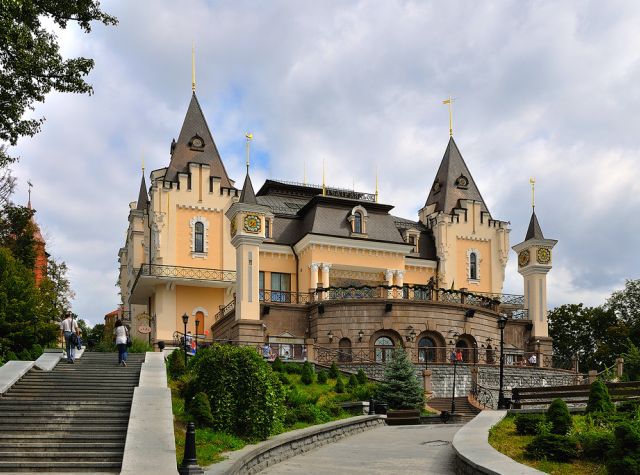 In 1993, this landmark of Kiev received its modern name — Kreshchaty Park. It was recognized as a monument of garden and park art of local importance. The popularity of this place for vacation in Kiev was enhanced by the relocation of the Kiev Puppet Theater here. Pierrot and Malvin were evicted from the synagogue Brodsky occupied. But in 2005 a real Palace was built for the theater. Carlo Collodi’s and Alexei Tolstoy’s heroes once dreamed of such a thing, and in Kiev, in front of the puppet theater, another luxurious observation deck was formed — with a view of European Square and new life prospects.