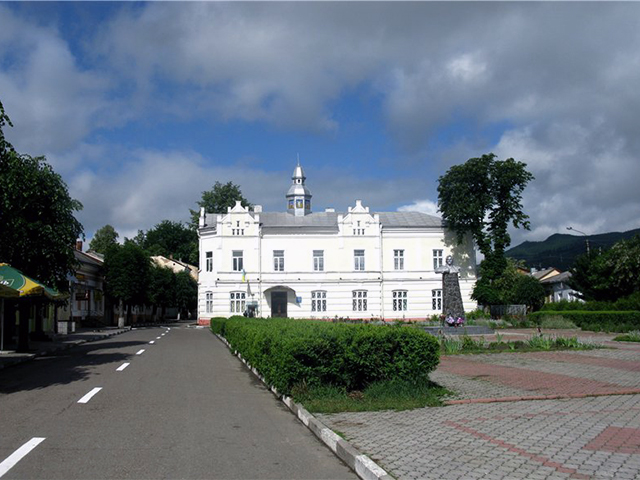
 Tiny Vizhnica has a set of sights that would make even the «small cultural cities of Europe», which are not poor in such a good thing, fall into the sin of envy. For example, French Reims or Italian Savona, Spanish Santiago de Compostela and German Münster. The reason for the appearance of such a «cultural set for a tourist» was the complicated history of the smallest city in Bukovina.
Judge for yourself, Vizhnitsa was «made» a town by Austrian Jews in the early XVIII century. Before that there was only a fortress Gorodok na Cheremosha, consisting of a couple of towers and palisades. It was founded at the suggestion of Yaroslav Osmomysl with the hope that this construction would protect the inhabitants of the surrounding villages from Mongol-Tatar raids. The name «Vizhnitsa» appeared in 1501. It is associated with the weight of goods, with wagons, with cherries, but with the arrival of Jews in the city it acquired a new meaning. After all, the Yiddish word «Vizhnitz» means «entrance, opening, gate». So the ancient name became a symbol of the successful location of the city at the point of the beginning of the road to the mountainous country of the Carpathians — under Nemchich Pass, and on the way of the logging along the Cheremosh to the Prut.
 So, at the end of the XVIII century the urban population of Vizhnica was exclusively Jewish, and in the surrounding villages lived that amazing mixture of Hutsuls, Moldovans and Poles, which formed a special «Carpathian» dialect of the Ukrainian language. By the way, with an active infusion of Yiddish words.
Because of its national structure, this settlement — shtetl, was built according to the scheme characteristic of a European city. Before Vizhnitsa, its builders had seen Vienna and Krakow, visited Prague and Copenhagen. Therefore, the center of this Bukovyna settlement was Ratusha and the adjacent square. Taking into account that most of the locals were engaged in commerce, and the villagers from all the surrounding areas brought here the results of their labors, it quickly became the main trading platform in the region, i.e. the market. And naturally, soon the main square in Vizhnica became known as the Market Square. True, it did not upset anyone. After all, the same Market Square was the center square in a number of European cities, whether in Bratislava, Krakow, or Helsinki.
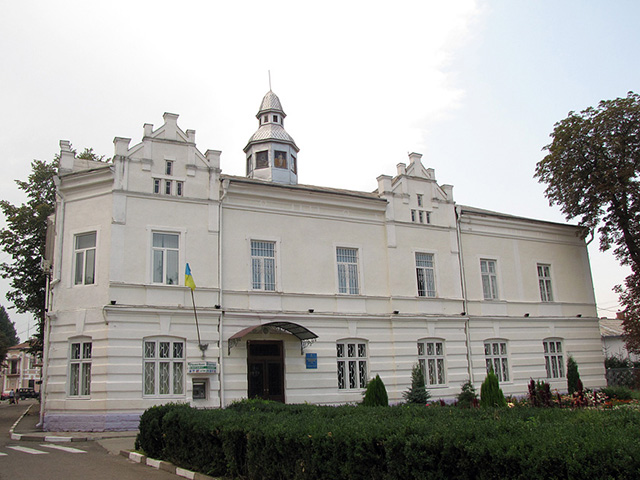
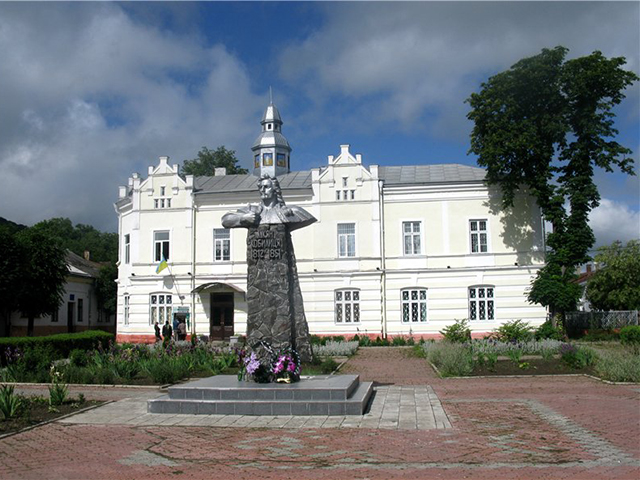 The only difference between the Market Square in Vizhnica and its European counterparts was its size. The local Jews did not spare the land, so today it has a park, paths for promenades and monuments to Lukyan Kobylitsa and Taras Shevchenko. But just as in enlightened Europe and most cities of the Austro-Hungarian Empire, the dominant building on the square was the Town Hall. It is not a small two-storey building, made in the form of letter «P». The style is classical, moderate and functional. The only decorations of the building can be considered five superstructures imitating the third floor and a graceful, decorative tower-signature, topped with an onion. The tower has eight sides and, like a medieval knight, is covered with sheet iron. Today the Town Hall is painted a pale yellow color and is protected from all weathers by a metal roof.
As it was intended, the Vizhnica Town Hall is home to the local government. During the Austro-Hungarian period the magistrate worked here, during the Romanian period the mayor’s office met here, and during the ZUNR period — the county government. Curiously enough, since 1991, the largest and most beautiful building on Town Hall Square has been taken over by the Treasury, and a couple of years ago it was taken over by the city court.
Naturally, the Town Hall and Market Square the sights of Vizhnica do not end. Somewhere there is a house that served as a Hasidic yeshiva for the entire Bukovina, a synagogue has been preserved, which houses the gymnasium of the Vasyl Shkribliak School of Applied Arts. In addition to 8 synagogues, there are 3 Christian churches of the century before last, parents’ hut of Nazariy Yaremchuka and the house of the former viit and famous writer Yuriy Fedkovich. Besides such cultural and architectural fireworks, a holiday in the Carpathians in these places guarantees amazing mountain scenery bestowed by the Carpathians and an excellent reception organized by the locals.