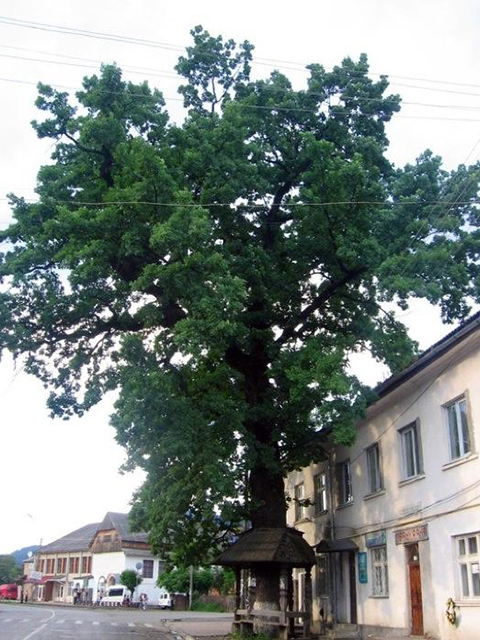
 One-fourth of all adult residents of Mezhigorie work at the local woodworking mill. The other quarter independently cuts and sells logs, cut and uncut boards, and sawn timber — privately cutting down once dense massifs of forests covering the slopes of Borzhava and Gorgan. Oak and pine, ash, spruce and birch go under the electric saw blade. The only tree in Mezhgorsky District, which is not threatened with death «from the axe» of licensed and black loggers, is the city’s five hundred-year-old oak.
The tree belongs to the Beech family, the species is the Common Oak. Possesses a not insignificant — about 20 meters, growth and a gorgeous tent-shaped crown. The waist of the only untouchable tree in the edge of loggers has already reached a meter and a half in circumference, and the dark gray bark of this plant is riddled with deep longitudinal age cracks.
The reason for this special position and the indulgence received by the oak tree from the intermountain loggers lies in the age of the tree. It is believed that it has already lived in the world for five hundred years. And this means that the acorn from which this beauty grew could well have been trampled into the ground by soldiers of the Polish-Lithuanian king Sigismund the First, going to war with Muscovy, by the Janissaries of Selim the First, who were fishing in these parts, or by the retinue of a high-ranking clergyman traveling through the valley rika to the Fifth Ecumenical Council. Unfortunately, the exact age of the tree will only be revealed by a cut of the tree, on which it will be possible to count the number of winters the Intermountain Oak has survived. But this is the way of determining the age of a plant that should be postponed at least for another five hundred years and take the locals’ word for it.
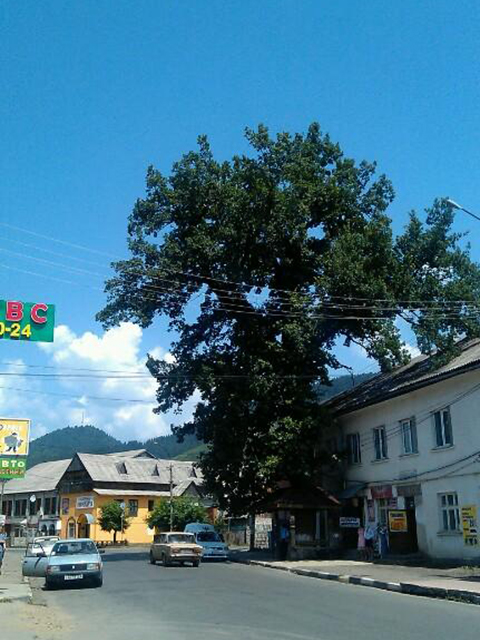 The oak tree grows almost in the very center of Mezhigorie, near the road where the roads from the Valley to Khust and from the Lower Gates to Bushtino converge. For the last four hundred years the tree «worked» as a landmark for travelers — it was used to determine the turn to the village of Soimy, which has mineral water reserves. Thanks to the oak tree, travelers can easily find their way to the location of the Shipot Festival, which is timed to coincide with the waterfall of the same name, or the best koliba, sauna or private estate in the locality, which provides «green tourism» services to its guests. And although today the oak is considered an honorable pensioner, having received the title of «natural monument», but it is still used as a signpost. After all, there is no more ancient and reliable landmark of plant origin in the village.
Recently the intermountain elder was surrounded by a multifunctional covered pavilion with benches. On the one hand, locals and tourists waiting for a bus to Khust, Ivano-Frankovsk or Uzhgorod, could sit down by the oak tree, sheltering from the rain, while on the other hand access to the tree was restricted to barbarians who wanted to immortalize their name or love story on its bark, already rugged by time.
Naturally, the five hundred year old oak tree and mineral water springs the sights of Mezhgorye are not limited to it. In summer, guests are offered excellent trekking along the ridges that clench the settlement in their arms, excursions to the Shipit waterfall or to the museum of «Forest and rafting», located in the village of Sinevirskaya Polyana. Winter vacation in the Carpathians in this area involves skiing from Makovitsa Mountain, as well as tasting the best dishes of Transcarpathian cuisine — banosh, mushroom borscht, and bograch, in which the meat component dominates over pepper, tomato paste, wine, and smoked lard.