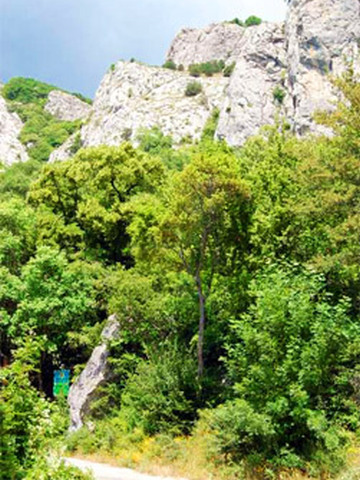
Shaitan-Merdven or Devil’s Staircase was a reliable and very important for the local population mountain pass of the Main Ridge of the Crimean Mountains.
Since the New Stone Age it connected the Crimean foothills with the South Coast. But the mountain pass was quite difficult, and one can easily imagine how a tired and stumbling traveler more than once grumbled and remembered the devil on the difficult parts of the ravine, through which the Devil’s Staircase ran. Hence its Crimean Tatar name Shaitan-Merdven (Shaitan — devil, Merdven — ladder). It is a strange demonic name, full of mystery and eeriness, but it calls the traveler to itself, attracting the magic of mystery.
Why was the Devil’s Staircase built in the mountains? In the past, the rock barrier of the Southern Ridge not only protected the South Coast from cold northern winds, but also served as a stone wall with precipices and chasms, impregnable for nomadic invaders. But there was a need for mountain trails and roads, where a wagon, pedestrian and equestrian could pass, and which would connect the south and north of the peninsula.
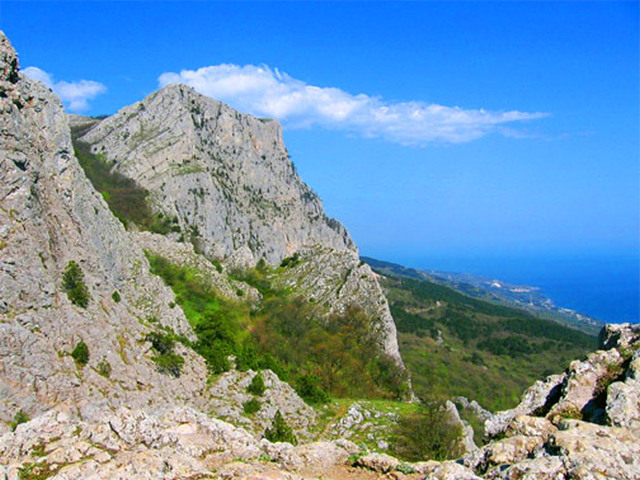
This is such a natural passage among the rocks between the high cliffs of Merdven-Kaya and Balchik-Kaya served as a narrow gorge, where people laid a stone staircase and used it until the last century, until the road through the Baidar Gate was built. And the mountain staircase was forgotten, destroyed, and now only tourists climb it.
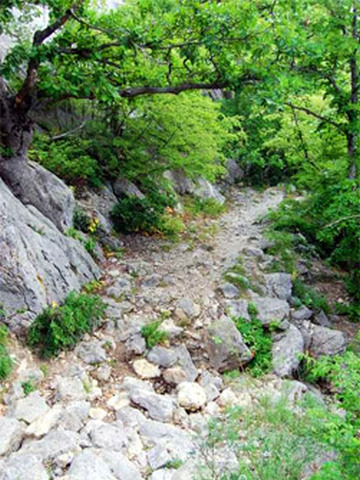
Now for the name Shaitan Merdwen — Devil’s Staircase. It’s called so because of the large slabs, outcrops of limestone that really do resemble huge staircase steps (but it’s much more noticeable from the sea side).
The height of the pass is 578 m above sea level; its length is about a kilometer. It seems that not to the staircase itself, but to the whole gorge, a mountain amphitheater with formidable and harsh rocks, truly devilish relief was given such an apt name. But at one time it was the most convenient pass on the way from Yalta to Sevastopol, until modern roads were built. The old Yalta-Sevastopol road lies just next to the Devil’s Staircase.
From the village of Opolznevoe to her 9 kilometers along the cascades of rocks with complex relief. Behind the rock Khergiani, after passing a small bridge on the highway, near the well-maintained grave of Crimean partisans with a memorial plaque, the path branches upwards. Through the bend under the bridge flows a mountain stream surrounded by boulders and limestone blocks. The trail goes up a steep slope. Under your feet you can see petrified clays and sandstones, the oldest rocks of the Crimean Mountains.
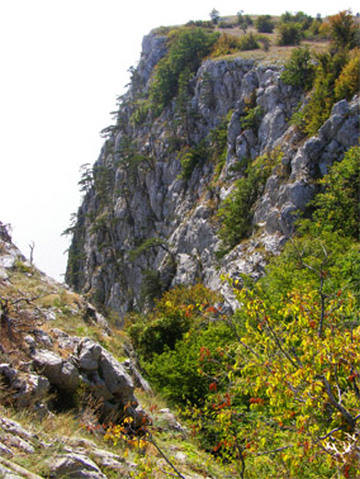
The forested slope is not dull to the eye, with blocks and cliffs of limestone scattered everywhere, blasted off the Main Ridge cliff. Small steep-walled valleys, left by temporary water streams, contribute to the diversity of the dense thickets.
Walking along the path, you can see the road crepits, stone marches, and the remains of side walls. Now much has collapsed, and only a traveler can pass here, and earlier horses clattered their hooves and wagons drove. To this day, on the flat curves of limestone, on the rocky base, lying in the roadbed, one can still see the paired ruts made by the wheels of wagons.
Mountaineering ascents and climbing competitions, from the All-Union rank to the World Cup, were held here more than once. And in memory of the famous «Tiger of Rocks» one of the cliffs is named after Hergiani. However, few people know Khergiani cliff, only climbers who are well versed in the faces of the Crimean mountains can show it.
Merdven, Shaitan-Merdven, Ladder, Staircase, Devil’s Staircase… There are no more such toponyms in Crimea, although there are roads through the Main Ridge and other gorges. So, this particular road is of special interest. Shaitan-Merdven or Devil’s Staircase is not only a convenient passage to the yaila by steps and platforms. It absorbs the whole relief of the winding and steep path.
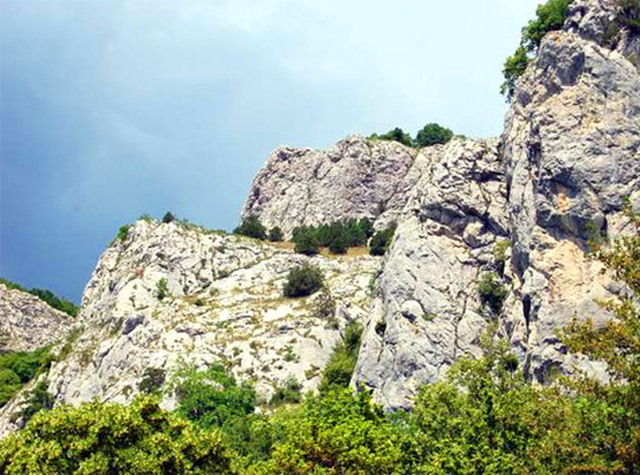
Behind the boulder bulk at the edge of Merdwen Kai the famous gully of the Devil’s Staircase begins, steeply descending to the pass saddle. The length of all marches, taking into account the slope, is about 250 meters, the average steepness of 15-20 degrees, the slope of some marches reaches 30 degrees. The width of the cloth is up to one and a half meters. The ascent from the entrance to the gorge to the exit from it is a little less than a hundred meters vertically.
The loops of the Devil’s Staircase wind along the natural stone rubble at the bottom of the gorge and along the shelves and ledges of Merdven-Kaya. In some places up to half a meter of limestone had to be cut down, and a man worked hard here, cutting off the ledges, widening the road among the stones, building crepids — retaining walls. Nowadays only three turns have been preserved and are clearly visible.
Of course, a fortress was necessary to protect the gorge with a trade route. There are many ruins of such castles on the South Coast. From the Tatars they received the name — Issar (wall, fortress), but the castles have nothing to do with the Tatar period of the history of Crimea. Issars are from the Middle Ages.
In ancient times, the route of Roman legionaries (old Roman road), connecting the fortress of Kharax on Ai-Todor and Chersonesos, passed through Chertova Gora. In summer, ships of the Ravenna squadron delivered cargoes there, but winter storms prevented coastal navigation, and then the main highway became the road through the Devil’s Ladder. Fierce bloody battles broke out here more than once.
Sometimes in the heat of summer a draught comes through the Devil’s Staircase. You walk, blown by the coolness of the rocks and forest thickets, and it seems like a whiff of dampness from the distant ancient days.
Abandonment and silence cautiously settle down next to you, but strain your ears and you will feel how silent the ruins of fortresses are in the dense thickets, and holy relics rest in secret caves.