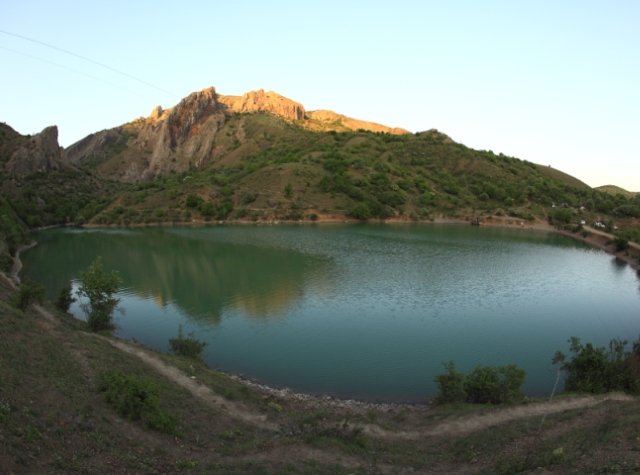
 Panagia tract is not as famous as the Grand Canyon or Ai-Petri. Located almost in the wilderness, it is better known to hikers than to those who call themselves «civilized» tourists. The route along the wonderfully beautiful gorge starts right behind the outskirts of the village of Zelenogoroye, a small village in Sudak district.
In Zelenogorie a little more than 200 inhabitants — as many as in the average size «Khrushchevka». But by the amount of beauty per capita it, perhaps, will overtake any capital. Here, besides the canyon, there is also the most picturesque mountain lake and bizarre rocks.
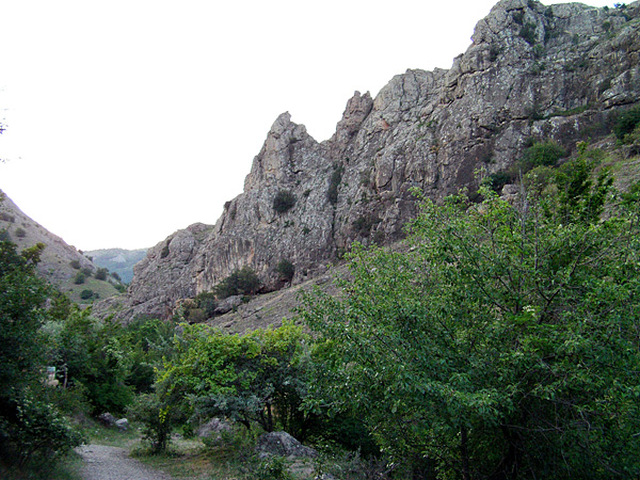 The old name of Zelenogorye is Arpat. Like many Crimean toponyms, it has no exact interpretation. Most likely, the name comes from the Tatar «arpa» — «barley». The lands here are arid, not suitable for gardens and orchards, except that unpretentious barley was successful on them. The same name was (and still is) given to the river descending to the village from the north. Do not be surprised that in the lower reaches of the river is called Arpat, and in the upper reaches — Panyan-uzen, because the names were given not to rivers, but to localities or tracts and from them were transferred to the river.
Just after the village, the river waters, breaking through conglomerates, cut through a small, but narrow and winding gorge. It is not very long, but it is a continuous cascade of waterfalls and erosion cauldrons called baths in common parlance. On the kilometer-long section here are no less than 10-15 waterfalls of different sizes, following, literally one after another almost continuous succession, interspersed with rounded bathtubs. 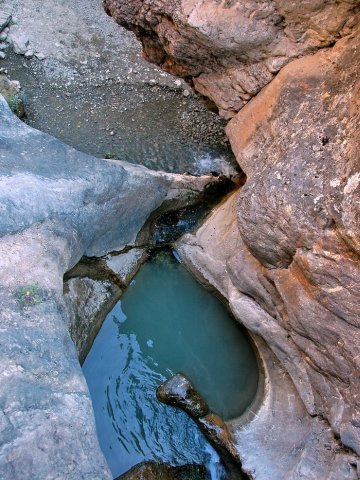 It is this part of the tract that is the most picturesque and attracts the bulk of visitors.
The so-called Bath of Love is especially popular among tourists. On the ledge between the two waterfalls, the water washed out a hollow in the shape of a heart. There is a tradition to bathe here together with a loved one, so that love would be eternal.
The water in the Arpath Baths is not as cold as it is in the Grand Canyon. It has time to warm up on the way from the source, as it flows not in a deep gorge, but through open and well-baked by the sun. It is said that the water from Arpat is a good remedy for all kinds of skin problems (eczema, fungus), but we cannot vouch for the reliability of the information.
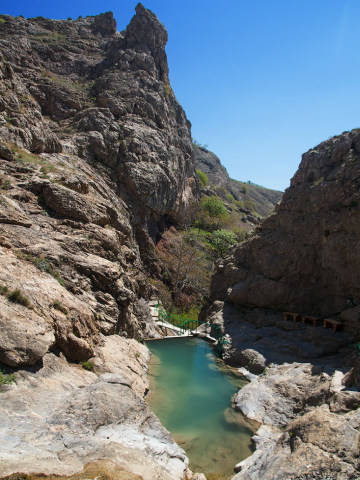 Above the bath of Love is a rather deep and spacious «puddle», in which you can not only dip, but also swim. The origin of the «puddle» is artificial — the channel was blocked by a concrete retaining wall and thus a miniature reservoir was created. Filling it to the brim, the water overflows over the wall and flows further.
The rocks above the «reservoir» rise steeply upwards, creating the impression of an impassable gorge. However, it used to be quite difficult to access, until someone thought of «cultivating» it by building bridges between the rocks, putting ladders on steep rises, and in some places hewing the rock to make a convenient passage. Now everyone can walk along the tract.
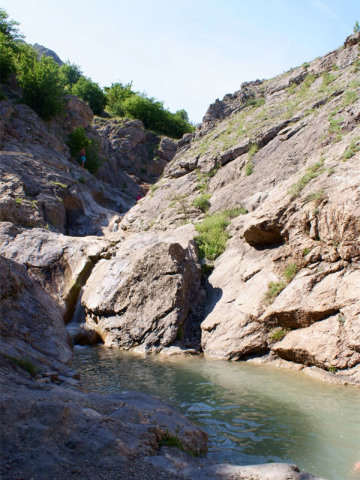 After the «reservoir» there are several more waterfalls and tubs. The rocks of the river bed polished by the stream and covered with a smooth cover of yellowish tuffolite deposited by water, in some places have bizarre outlines. The riverbed itself winds between them, creating a stone and water labyrinth.
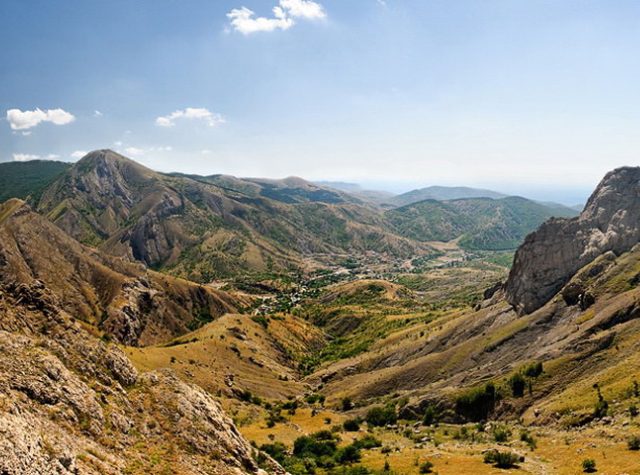
Above the gorge cut in conglomerates, the river turns into a calm, almost flat one. The terrain here is composed of rocks of the Taurian series, which are softer than conglomerates and easier to erode. Gorges are never formed in such rocks. That is why the river here flows calmly through the picturesque green valley and is no longer called Arpat, but Panyan-uzen. The valley itself is called Panagia tract.
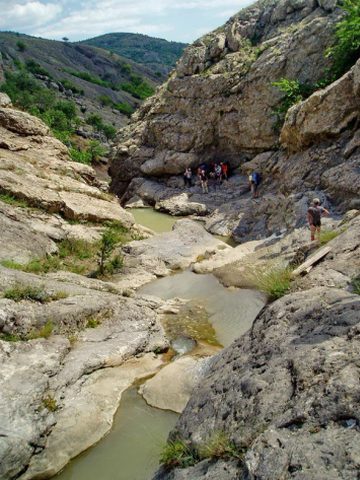 Panagia in translation from Greek means «all-saint» (pan-all, agios — holy) — it is one of the epithets of the Virgin Mary. In ancient times there was a small monastic hermitage here. Probably, the name has been preserved from those times. The hiking path along the tract is not difficult. The path runs along the river bed, or next to it. The slope is not very steep. After about 10 minutes of walking from the gorge, there will be another waterfall, formed in the place where the river overcomes a conglomerate ledge. Above, there is a flat road again. Grassy hills stretch along the left bank. The right bank is steeper.
Here inquisitive travelers can get acquainted with the rocks of the Tauric series — the oldest rocks of the Crimean mountains. They are composed of almost the entire area from Alushta to Sudak. On the South Coast they are also there, but they lie deep, under the thickness of strong Upper Jurassic limestones. 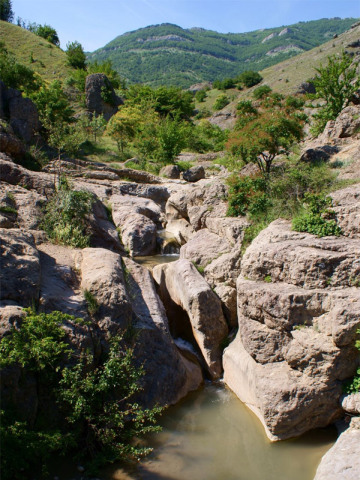 That is why the relief of these areas is so different — precipitous steep slopes of the South Coast and soft, almost gentle outlines of the mountains behind Alushta. And the color of the mountains here is also characteristic — gray-purple. The same color and the right bank of our river. Tourists often pay attention to parallel layers of stone, sticking out of the slope and resembling either masonry or the remains of a slate roof. These are interlayers of sandstones — more durable than other rocks of the Tauride series. The fact is that the Tauride thickness resembles a layer cake, in which alternate layers of sandstones, clay shale rocks called siltstones. Siltstones are cemented sedimentary rocks, the diameter of mineral particles of which is 0.01-0.05 mm.
Moving along the riverbed, we will soon reach the confluence of two tributaries. Local historian I. Belyansky discovered the remains of a medieval hermitage in this place.
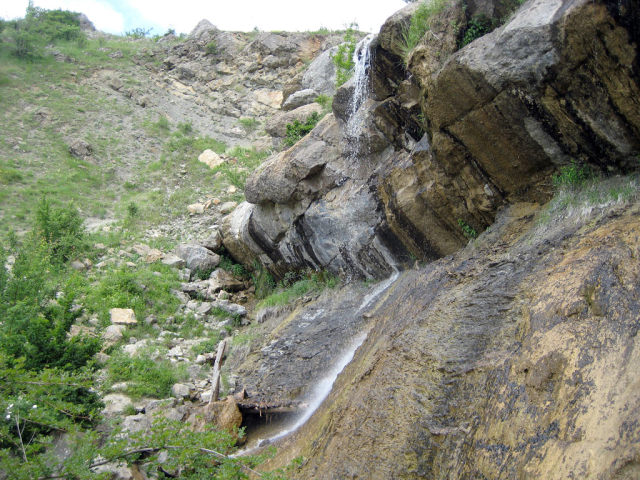 A few more minutes of movement and we will see a 10-meter waterfall. This is the Panagia waterfall. Its power is not great. In summer — just a few streams, but it is not devoid of picturesqueness.
The waterfall is the end point of our route, although the trail does not end near it. It rises higher and there, increasing the slope, climbs up the mountain — to the Gorucha Pass. Following it you can get to Belogorsk. But if we came by car, we’d better go back.
The route from the gorge to the Pagangia waterfall will take no more than 40 minutes. The same amount of time will be spent on the way back.
 After the hike, returning to Zelenogorie, it is worth refreshing in the picturesque mountain lake, which is very close to the outskirts of the village — you just need to climb the hill to the right of the parking lot. A wide dirt road leads there.
Even if you have already seen a lot in Crimea, a trip to these places will not be boring. There is really something special here, something unique.