 Alupka is one of the most popular places on the southern coast of Crimea. People are attracted here by the picturesque nature and the famous Vorontsov Palace, which harmonizes with the sharp prongs on the top of Mount Ai-Petri. Its northern facade, gray to match the color of the mountains, resembles a medieval castle, and the southern, facing the sea, — a fairy-tale oriental palace. The park around the palace is also beautiful. There are plants from different parts of the world planted between ponds, cascades and streams. The attraction of the park are two stone chaoses — piles of huge stone blocks from diabase rocks destroyed by time.
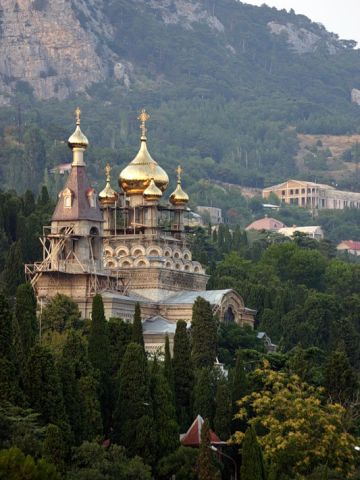
In the city, not far from the palace, there is a temple, the history of which is very interesting. By the end of the XIX century, the population of Alupka has greatly increased, and the temple built in 1820 at the expense of Count Vorontsov was destroyed by a landslide. Therefore, the decision of local residents to build a new church was supported by the Tauride Ecclesiastical Consistory. The place for construction was chosen carefully and cautiously so that the church would not suffer from frequent landslides in these places. Civil engineer Ya.P. Semenov, architect O.E. Wegener and other specialists decided to build the church in the center of Alupka, next to the old cemetery.
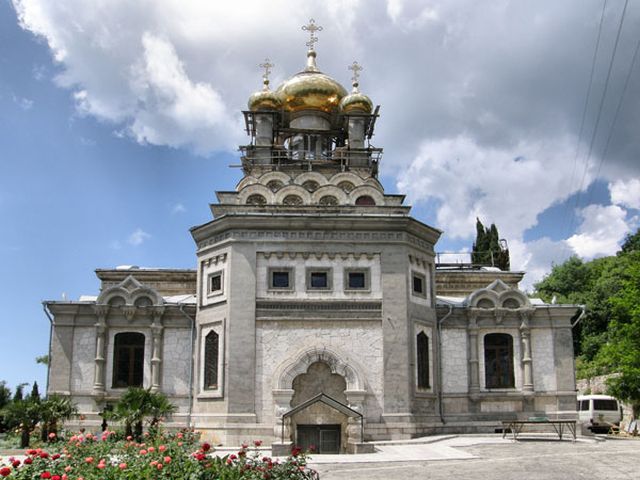 October 2, 1902 approved the project, developed by Khrisanf Vasiliev, and began to collect funds. The main capital was 45 thousand rubles bequeathed by Sophia Vyalykh-Flegontova.
On October 26, 1903 the solemn laying of the foundation stone took place, but the construction went on, due to lack of money, with interruptions. We even had to send letters to rich people asking for donations. Many famous and wealthy people in the Crimea readily responded to the request for help, among them Vorontsov-Dashkov, Maltsov, Milyutin. The Emperor allocated 2800 rubles for the production of gilded domed crosses.
Priest V. Troepolsky put a lot of effort and energy to complete the construction of the church as soon as possible. Due to the lack of funds instead of a bell tower a wooden belfry for seven bells was built. November 8, 1908 on the day of Archangel Michael the church was consecrated.
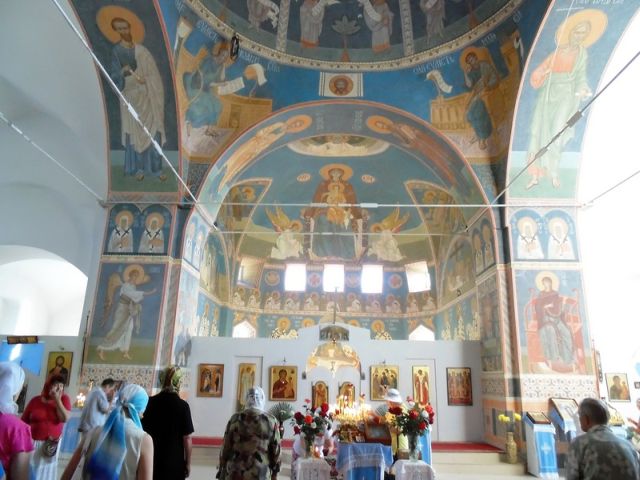
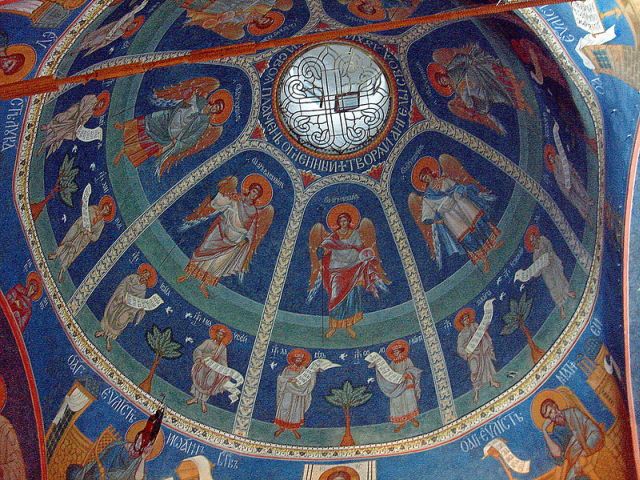 The cross-shaped temple was built in the Russian style. Five chapters proudly ascended to the sky. Gasprin and Inkerman limestone was used for the construction and finishing of the walls. Inside the temple was decorated with paintings, from the ceiling hung a huge chandelier made by Yalta craftsmen. The iconostasis was made in St. Petersburg in the workshop of artist V.S. Lapin.
Twenty years in the temple were services. In 1912 here was buried a famous military, historian and reformer of the Russian army, Field Marshal General DA Milyutin. After the revolution, many churches were closed, but the residents of Alupka in 1923 appealed to the local authorities with a request to give them free and perpetual use the temple of St. Michael the Archangel. The authorities gave permission, and the temple was not closed. However, in 1927 in the Crimea there was a strong earthquake, as a result of which the temple was seriously damaged. It became unsafe to visit it, and there were no funds for restoration. In October 1927 the church was closed.
 In 1932, the church decided to dismantle, the crosses were removed from the domes, but the building itself was still preserved, having set up a warehouse here.
In 1990, the Church of St. Archangel Michael was again transferred to the Orthodox Church, began restoration work. In November 1991, the rector of the church, Father Valery Boyarintsev held the first service, which was held right in the churchyard. Then services began to be held in the lower part of the church. Finally, the restoration was completed. The right side of the church was consecrated in honor of St. Nicholas the Wonderworker.
Another Crimean temple was saved from destruction. Currently, restoration work is underway. Reconstruction of the domes of the church is being prepared.