 .
.
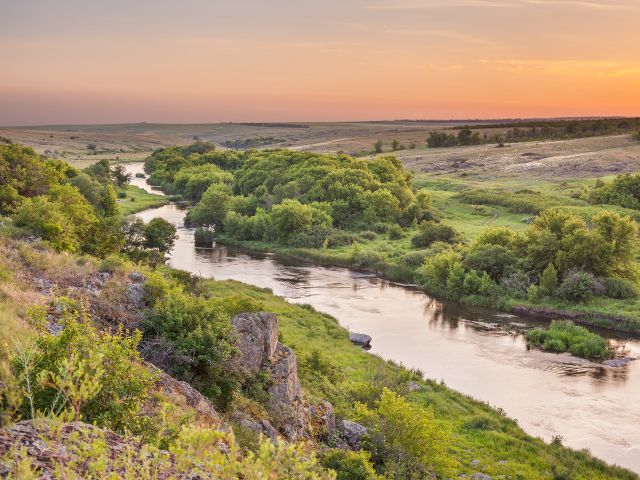
The Donetsk ridge (or rather its southern slope) in Ukraine gave rise to a flat river called the Kalmius. Passing through several districts of Donetsk region, Kalmius reaches the city of Mariupol, where it becomes part of the Sea of Azov. The total length of the Kalmius is just over 200 kilometers. The average width of the river is about 10-15 m, except for the center of the city of Donets, through which Kalmius passes. Here the distance from bank to bank reaches up to 400 meters. Despite its not very outstanding size, Kalmius has 4 left tributaries and 5 right tributaries.
On the banks of the Kalmius there are as many as 16 settlements, among which there are large cities such as Donetsk and Mariupol. Also the waters of the river are widely used in the national economy, 4 reservoirs were created on the basis of Kalmius.
 .
.
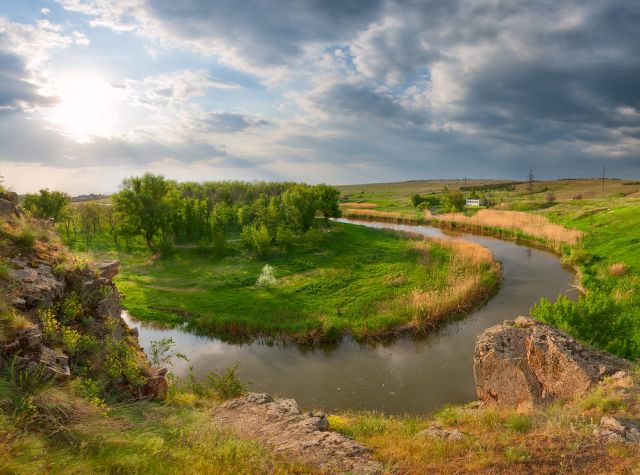
Since the XIX century and to this day scientists can not come to a unanimous opinion on the origin of such an unusual name of the river. During this time several versions have been developed. At the moment it is believed that «Kalmius» is of Turkic origin and means a compound of two words: hair and horn. «Hair» implies a small width of the river, and «horn» — the direction of its flow.
On the territory of one of the districts of Donetsk region the river Kalmius changes its direction from southeast to southwest. Hence the resemblance with a curved horn. This version is the most widespread, however, there is documentary evidence that the river received its name long before the invasion of the Tatars into what is now Ukraine. The Crimean khan in his letter says that the Tatars have nothing to do with the word. There is also an opinion that «Kalmius» means «nomadic passage».
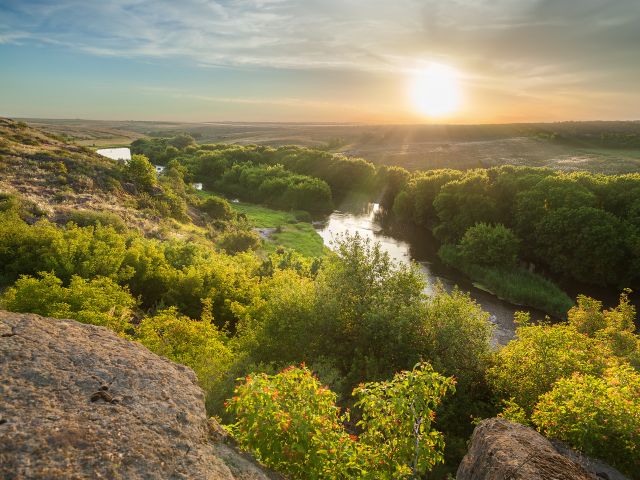
According to research, in ancient times, herds of livestock were driven up and down the river, which led to the formation of the river’s name. The study of the name Kalmius led to other unexpected results.
Along the riverbed there are 17 monuments of nature, archeology, architecture. One of them — a rock outcropping — is unique. There are only two of them in the whole world, one is here, the second one is in Argentina.
According to historians, the battle described in the «Tale of Igor’s Campaign» took place on the Kayala River at its confluence with Kalmius. Nowadays Kalmius has become a popular place for recreation for residents of towns and villages located along its banks.
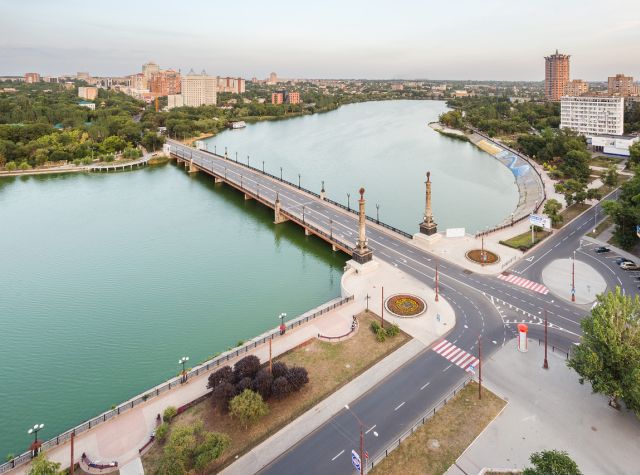
The coastal territories were landscaped, forest and park areas appeared along the banks. And the Lower Kalmius reservoir in Donetsk became a venue for sailing regatta competitions.
In recent years, environmentalists have been very concerned about the state of water in the river. In their opinion, the river may simply disappear. And the ban on bathing in the Kalmius River is no longer a surprise to anyone. Water pollution is mainly caused by emissions from the enterprises of Mariupol (MMK «Azovstal», Ilyich Iron and Steel Works and other smaller enterprises), as well as very close to the mine waters of coal mines. Scientists are sounding the alarm and doing everything possible to achieve the revival and purification of the river.