 .
.
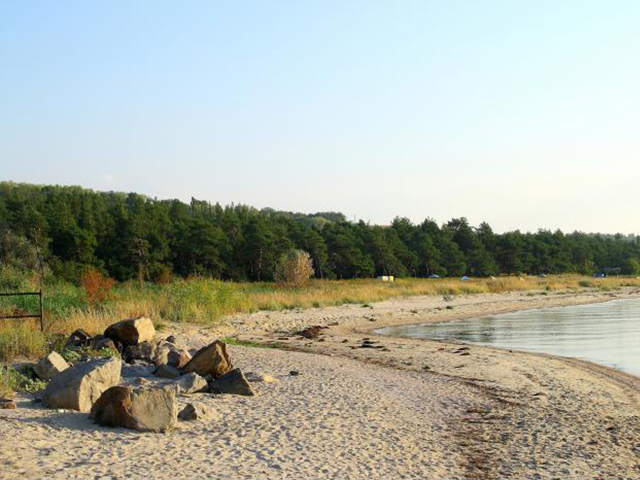
The natural monument «Pine Cultures» appeared in the Azov region in spite of this very nature. All plants, which became the basis of this conservation area, were planted by employees of Yalta forestry Pershotravnevogo district. The decision to green the shore of the Azov Sea was made in 1954 by the Donetsk Regional Executive Committee. In 1972, the same administrative body granted the young pine forest the status of a natural monument.
So, the common pine was planted in the fiftieth quarter of Yalta forestry. Please do not confuse the village of Yalta in Mariupol district with the brilliant resort city on the South Coast of Crimea. The tree line begins at a distance of 20-50 meters from the surf line. In this way the ecologists tried not only to green up a potentially recreational area, but also to maximally strengthen the sandy shore, which was regularly eroded by the waves of the Azov Sea. By the way, the waves have already «erected» the most famous sand spits in the southeast of Ukraine — Belosarayskaya, Arabatskaya, Fedotova and Krivaya — from the construction material «looted» from the shore.
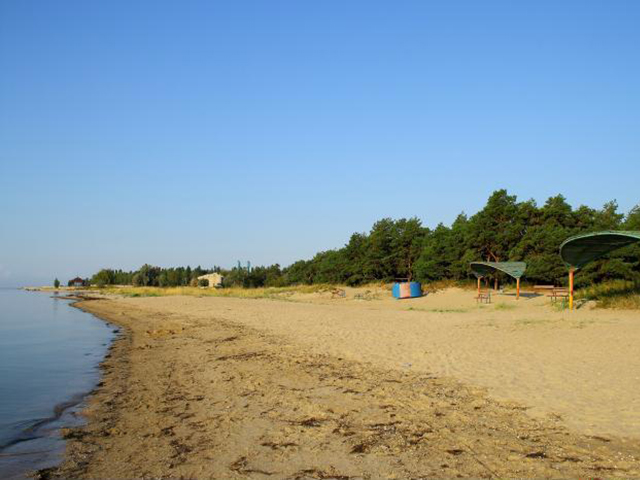
The pine plantings took up nearly 7.8 hectares of gold-bearing waterfront land. However, due to the fact that the plants were planted not in soil, albeit low fertility, but in sand mixed with broken shells, only two-thirds of all seedlings survived. Due to the extremely poor base and close proximity to salt water, almost all conifers from «Pine Cultures» have distorted trunks, asymmetrical crowns and bark covered with deep cracks. They are very different from the perfectly slender and beautiful trees of the Russian and Canadian taiga. They are more like the result of Japanese bonsai — the art of warping and disfiguring trees in order to make them picturesque. All Azov pines have an eerie but extremely picturesque appearance.
In addition to the migrant — the common pine, this strip of the Azov Sea shore was eventually inhabited by the Colchis sedge and Black Sea spikegrass, immortelle and Tatar katran, thickets of rosehip and bare licorice, which perfectly tolerate the absence of humus in the sand and can exist using salt water as the main nutrient solution.
Therefore, the natural monument «Pine Cultures» can be considered a memorial to the persistence of those trees that have adapted to life on the shore of the Azov Sea. In addition, it has become the only array of coniferous trees in the south of Donetsk region and a recognized landmark of Priazovia. And those who have planned vacation on Belosarayskaya Spit, it will be useful to know that the twisted pines regularly saturate the air with phytoncides, turning it into a healing gaseous balm.